
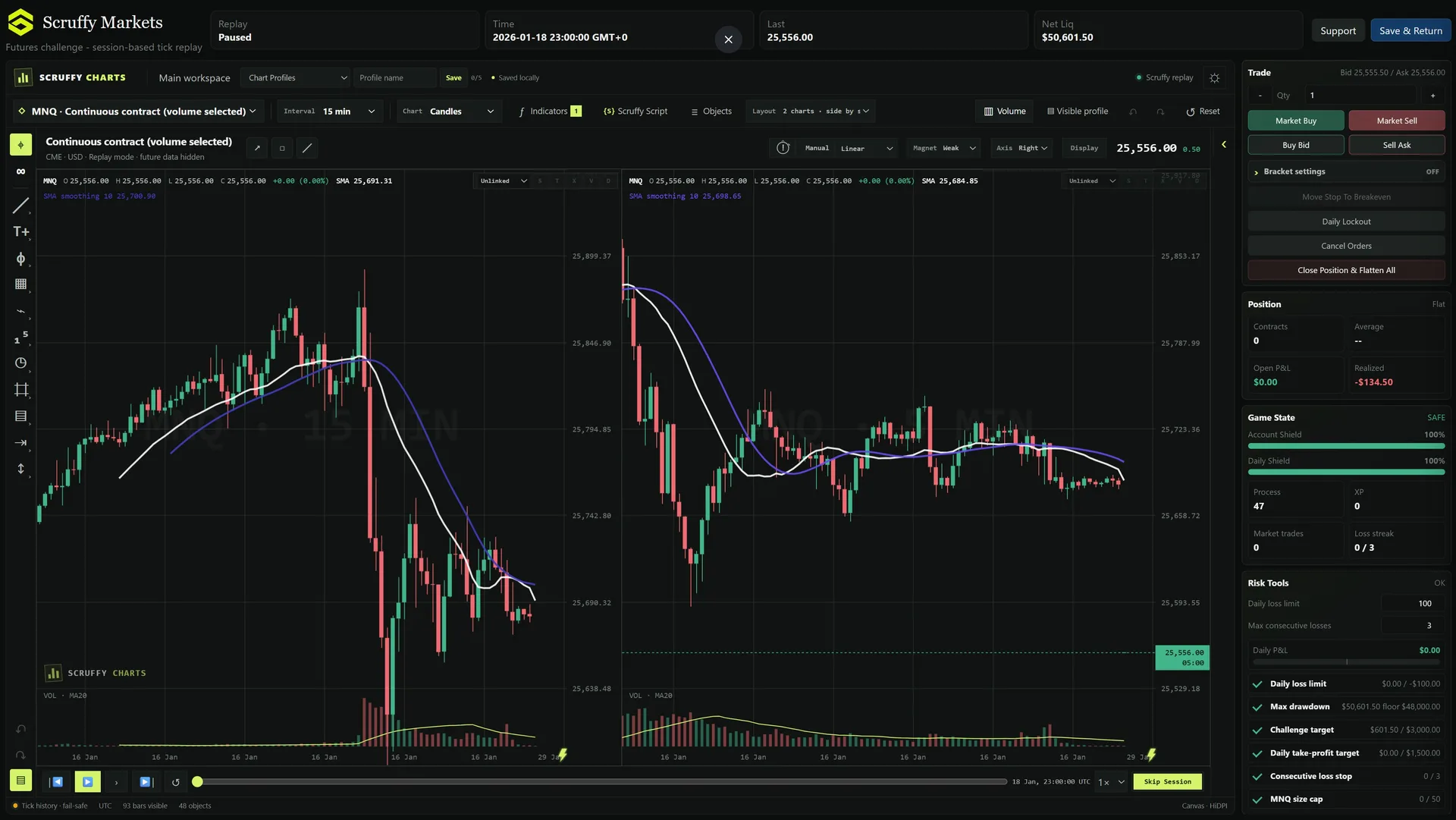
Trading futures with real money can be a fairly unforgiving way to learn the basics. A simple mistake with an order, an oversized position or a badly placed stop can turn what should have been a useful lesson into an expensive one.
That is where paper trading futures can be useful. Instead of learning while your own capital is on the line, paper trading gives you somewhere to practise the mechanics of trading, develop a strategy and work on your execution using simulated money.
The important thing, though, is how you use it. Opening a demo account and taking random trades is unlikely to teach you very much. Used properly, paper trading should feel less like playing with fake money and more like a structured training environment where every session has a purpose.
What Is Paper Trading in Futures?
Paper trading is simply simulated trading. You follow a futures market, make trading decisions and place trades using virtual funds rather than money from a live account.
Modern platforms usually record those simulated trades automatically. Your balance rises or falls depending on what happens to your positions, just as it would in a live account, but no real money changes hands.
For a futures trader, that might mean practising markets such as MNQ, NQ, MES or ES while learning how entries, stops, targets and position sizing work. It gives you room to make mistakes, understand the platform and become comfortable with the basic process before introducing real financial risk.
That does not mean the objective is simply to see how much fake money you can make. The value comes from using the simulator to practise making better decisions.
Why Is It Called Paper Trading?
The term comes from a time before modern trading platforms existed. Traders would literally write hypothetical trades down on paper, recording where they would have entered, where they would have exited and whether the trade would have made or lost money.
Technology has changed, but the idea is still the same. Instead of placing a real order, you record what would have happened.
The difference today is that a good trading simulator can do much more than maintain a pretend balance. It can allow you to use realistic order types, position sizes, stops and targets while also keeping a record of your performance for later review.
How Does Futures Paper Trading Work?
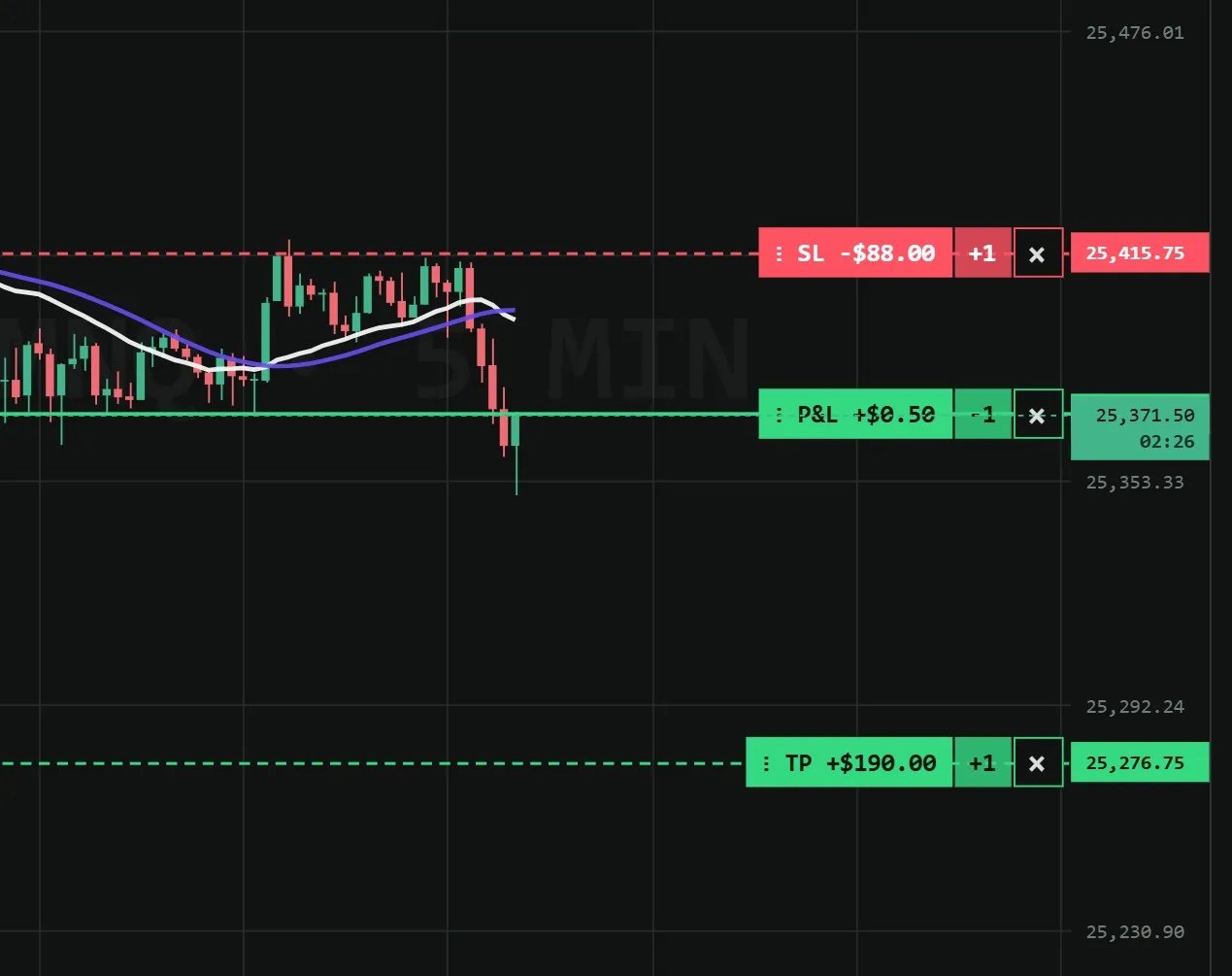
Imagine you start with a simulated $50,000 account and decide to practise trading MNQ. You identify a setup, enter one contract and place a stop below the level where your trade idea would no longer make sense. You might also place a target based on the risk-to-reward rules in your trading plan.
The market then moves exactly as it normally would. If your stop is reached, the simulator records a loss. If your target is hit, it records a profit.
Nothing about the money is real, but the decisions still can be. You still had to identify the opportunity, decide whether it met your rules, define the risk and then manage the position while the market moved.
That decision-making process is where the real value of paper trading begins.
Why Practise Futures Before Trading With Real Money?
There are some mistakes you simply do not need to learn with real money.
If you are still trying to remember how a stop order works, how many contracts you have selected or where to place a target, there is little benefit in adding financial pressure at the same time. Paper trading gives you somewhere to become comfortable with those basics first.
Once the mechanics start to feel routine, your attention can move to the more difficult part of trading: following a process consistently.
You can begin asking better questions. Did the trade genuinely meet your setup? Was the risk appropriate? Did you enter too early? Did you move your stop because you became uncomfortable?
Those are the things that eventually matter far more than knowing where the Buy button is.
Learn the Platform Before You Worry About Performance
One of the easiest ways to make trading unnecessarily difficult is trying to learn the platform and the strategy at the same time.
Imagine your setup appears and, instead of concentrating on the market, you are trying to remember which order type to use, how many contracts are selected and whether your stop has actually been submitted. By the time you have worked it out, the trade may already have moved.
Paper trading allows you to remove that problem. You can practise opening and closing positions, placing stops, moving targets and managing orders until the mechanics become almost boring.
That is exactly where you want them to be.
When using the platform no longer requires much thought, you can concentrate on the decision you are actually trying to make.
Paper Trading Can Help You Test Your Rules
Once you are comfortable placing orders, simulation becomes much more useful as a way of testing whether you can actually follow a trading plan.
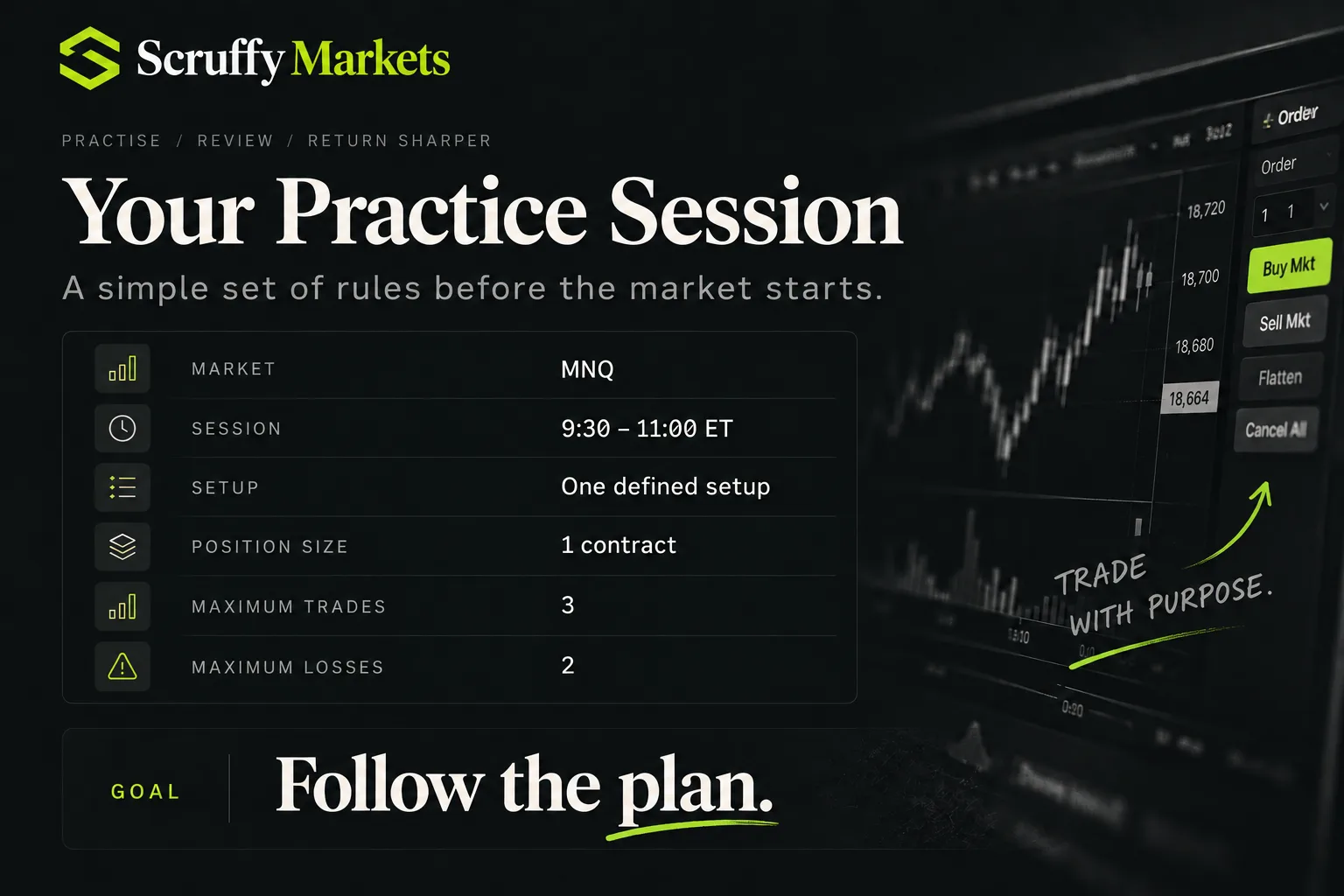
You might decide, for example, that you are only going to trade MNQ during the New York morning, take one specific setup, use the same risk on every trade and stop after either three trades or two losses.
None of those rules is particularly complicated on paper. Following them when the market is moving is often much harder.
That is where paper trading becomes valuable. It gives you somewhere to discover whether you actually trade the way you say you are going to trade.
If your plan says three trades maximum and you regularly take a fourth or fifth because you are frustrated, that is useful information. If you repeatedly move your stop further away when a trade moves against you, that is useful information too.
You are beginning to learn about the trader, not just the strategy.
The Biggest Limitation of Paper Trading
There is one problem with paper trading that cannot really be removed: the money is not real.
That changes behaviour.
Watching a simulated account lose $200 does not necessarily feel anything like watching $200 disappear from money you genuinely own. A trader who calmly allows a paper trade to reach its stop may behave very differently when the same trade is live.
This is why a profitable simulated account should never be treated as proof that somebody will automatically trade well with real money.
Paper trading can help you practise your strategy, execution and discipline, but it cannot perfectly reproduce the emotional pressure that comes with real financial consequences.
That does not make it useless. It simply means you need to understand what it can and cannot teach you.
Fake Money Can Create Bad Habits
Another danger is that simulated money can become meaningless.
You lose a trade with one contract, so you try again with three. That trade loses as well, so now you take ten. Eventually one oversized winner wipes out the previous losses and the account finishes the day in profit.
On paper, the result might look good. In reality, you may have spent the session practising exactly the kind of behaviour that would cause serious problems in a live account.
This is why the rules need to matter even when the money does not.
If you intend to trade one contract, practise with one contract. If your plan says stop after two losses, stop after two losses. If a trade does not meet your setup, do not take it simply because there is no real money at stake.
You are not trying to prove that you can make virtual money. You are trying to practise behaving consistently.
A Profitable Session Is Not Always a Good Session
This is one of the most important ideas to understand when you are paper trading.
Imagine you follow your plan perfectly, take two valid setups and both lose. You finish the day down.
Now imagine another session where you chase several trades, ignore your risk rules and eventually catch one oversized winner that puts the account into profit.
Which session was better?
Financially, the second one. From a practice perspective, probably the first.
The first session showed that you could follow the process even when the outcome went against you. The second rewarded bad behaviour.
If you judge every paper-trading session purely by profit and loss, you can end up teaching yourself the wrong lessons.
The quality of the decision matters just as much as the result.
Why Live Paper Trading Can Be Useful
One of the biggest strengths of live paper trading is that the market moves at its normal pace.
You cannot skip forward because nothing interesting is happening. If your setup takes 45 minutes to appear, you wait 45 minutes. If it never appears, the correct number of trades that day may be zero.
That sounds frustrating, but patience is part of trading.
A lot of poor trading comes from feeling that you should be doing something simply because you are sitting in front of the chart. Live simulation can help expose that behaviour because it forces you to experience the quiet periods as well as the exciting ones.
Sometimes the useful thing you practise is not taking a trade.
Paper Trading vs Market Replay
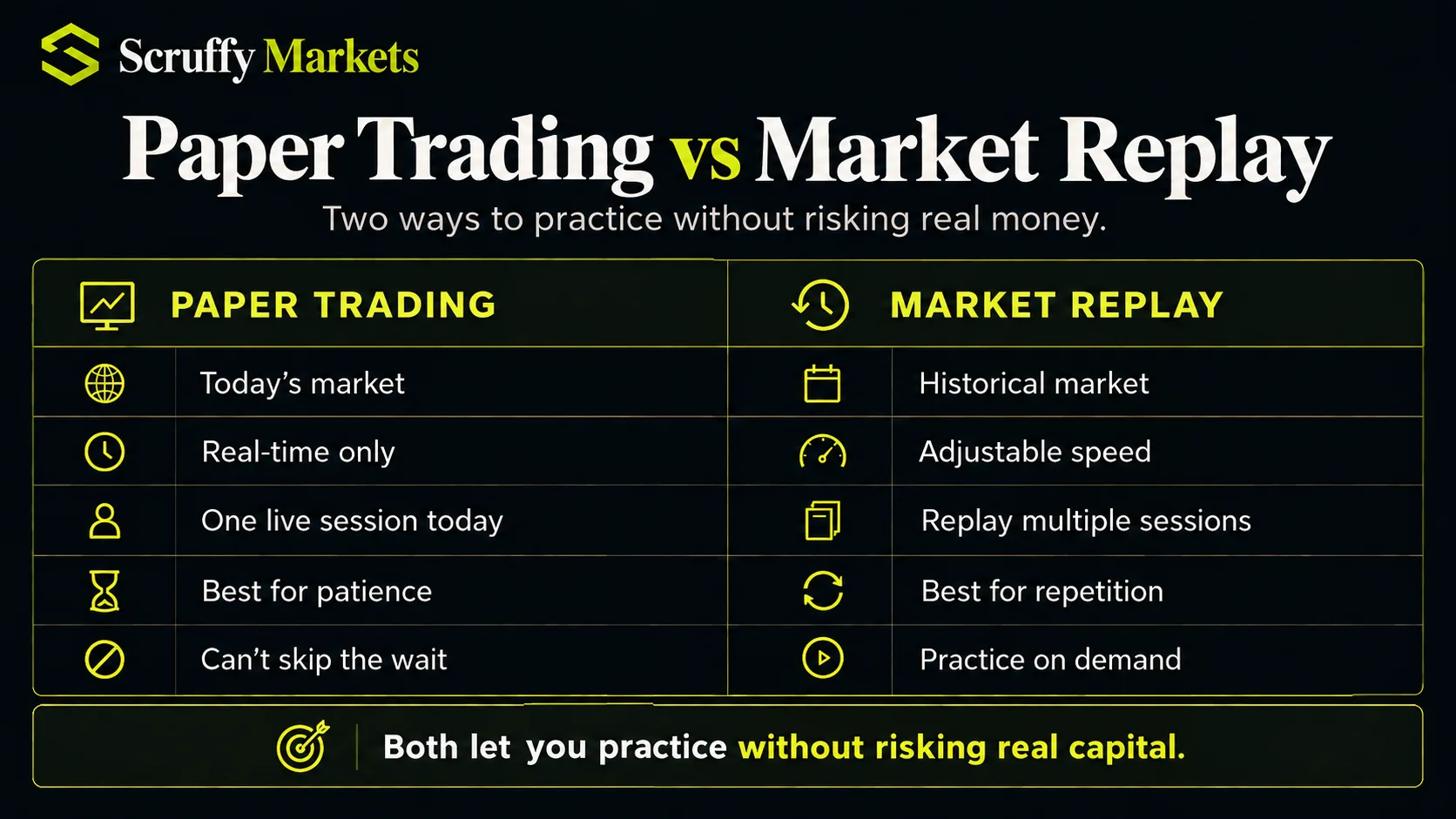
Paper trading and market replay are closely related, but they are not quite the same.
With live paper trading, you usually follow today's market as it unfolds. You experience the session at the same pace as everyone else and you only get one version of that day.
Market replay uses historical data. You can load an earlier session and trade it as though it were happening now, ideally without being able to see what happens next.
That gives replay one major advantage: repetition.
If you are practising the New York open, live paper trading gives you one New York open today. Replay allows you to work through previous sessions and practise the same type of decision many more times.
Paper trading, on the other hand, forces you to experience the waiting.
For most traders, the two methods can work very well together.
When Paper Trading Is Most Useful
Paper trading is especially useful when you already understand the basic setup and want to practise behaving properly during a live session.
Perhaps your problem is impatience. Maybe you take trades because you are bored or enter before your setup is fully formed. In those situations, being forced to wait through a real-time market can be extremely valuable.
It can also help you build a routine. You sit down at the same time, prepare the same way, wait for the same setup and finish trading at the same time.
That consistency is important because trading should not feel as though the rules are being invented while the market is moving.
When Market Replay Is More Useful
Market replay becomes particularly useful when you need more repetition.
Suppose you have discovered that you consistently enter breakout trades too early. You understand the mistake, but you may only get one opportunity to practise correcting it during today's live session.
With replay, you can load another historical day and work specifically on waiting for the correct confirmation.
That turns replay into deliberate practice.
You are not simply taking more trades. You are practising one behaviour repeatedly until it becomes more familiar.
How to Make Paper Trading Actually Useful
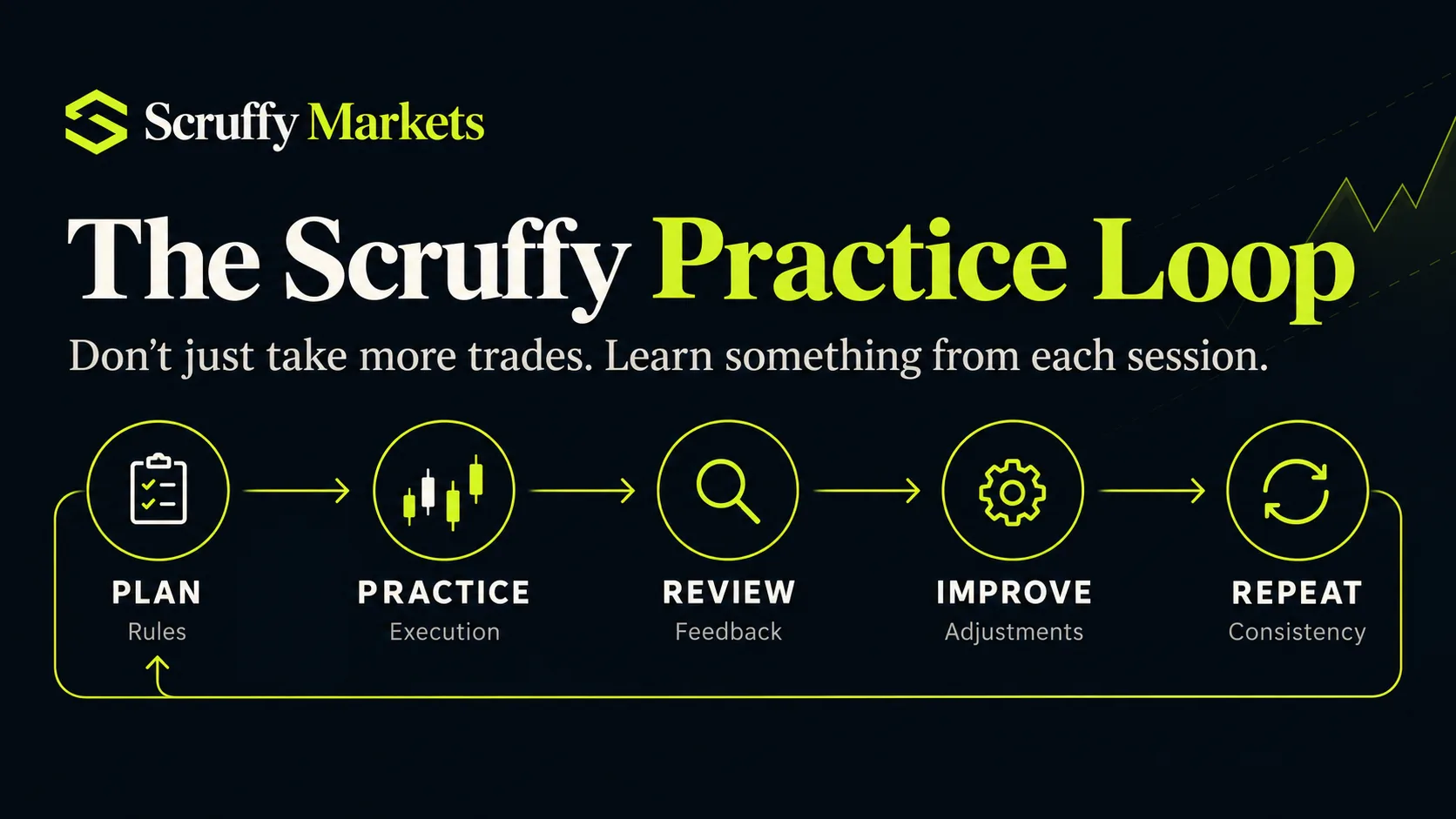
The easiest way to improve the quality of your practice is to decide what the session is for before you begin.
Choose one market and one trading window. Define the setup you are allowed to take, decide how much risk you will use and set a limit on the number of trades or losses you will accept.
For example, you might decide to trade MNQ between 9:30am and 11:00am ET, use one contract, take no more than three trades and stop after two losses.
You now have something measurable.
At the end of the session, you can look back and decide whether you actually followed those rules.
That tells you far more than simply looking at the final account balance.
Keep a Record of What You Do
Your memory is a terrible trading journal.
A few hours after a session, it is surprisingly easy to remember the sensible trades and quietly forget the ridiculous one you took because you were frustrated.
Recording your trades gives you something objective to review.
You do not need to write an essay after every position, but you should have enough information to understand what happened and why. Over time, patterns begin to appear.
You may discover that your first trade of the day is usually sensible but the third one is often unnecessary. You might notice that trades taken after 10:30am consistently perform worse, or that you take profit far earlier than your plan says you should.
Those patterns are difficult to recognise while you are in the middle of trading.
Review Before You Start Again
More trading does not automatically mean more learning.
If you finish one simulated session and immediately start another without reviewing what happened, you may simply be practising the same mistake again.
Take a few minutes to look at the session.
Ask yourself whether the trades actually met your rules, whether you respected your risk and whether your behaviour changed after winning or losing.
Then identify one thing to take into the next session.
Perhaps it is waiting longer for confirmation. Maybe it is leaving your stop alone. Perhaps it is simply stopping after your third trade.
That gives the next session a purpose.
How Long Should You Paper Trade Futures?
There is no magic number.
Fifty simulated trades does not suddenly make somebody ready to trade live, and neither does 500.
The more useful question is whether your behaviour has become consistent.
Can you clearly explain your setup? Do you understand how much you are risking? Can you follow the same rules after a losing trade? Do you know what your normal losing streak looks like? Can you stop when your plan tells you to stop?
Those are much better signs of progress than reaching an arbitrary number of paper trades.
Can Paper Trading Tell You If a Strategy Works?
Only to a point.
Paper trading can show you how a strategy performs during the sessions you trade, but the sample size may be relatively small. Ten days of simulation gives you information about those ten days, not necessarily about how the strategy behaves across hundreds of different market conditions.
That is where backtesting can also be useful.
Backtesting allows you to examine a strategy across much larger amounts of historical data, while paper trading gives you a better sense of whether you can actually execute the strategy in real time.
The two methods answer different questions.
Backtesting helps investigate the strategy.
Paper trading helps investigate how you trade it.
Can You Paper Trade for a Prop Firm Challenge?
You can certainly use simulated trading to practise within rules similar to those found in prop-style evaluations.
You might set a starting balance, a daily loss limit, a maximum drawdown, a contract limit and a profit target. You then trade while treating those limits as though they were real.
The useful part is not pretending that you have passed a challenge.
The useful part is discovering whether your normal trading behaviour works within those restrictions.
If you repeatedly breach a simulated loss limit, buying a real evaluation is unlikely to fix the problem.
You already know what needs work.
Common Paper-Trading Mistakes
Most bad paper trading comes down to a few recurring problems: taking far too many trades because there is no real consequence, constantly changing strategy after a loss, using position sizes that bear no relation to how you intend to trade later, and ignoring losing trades when reviewing the session.
The common thread is inconsistency.
If every trade uses different rules, different risk and a different strategy, there is very little useful information to analyse afterwards.
Good practice needs some boundaries.
Without them, simulation quickly turns into clicking.
How Scruffy Markets Approaches Trading Practice
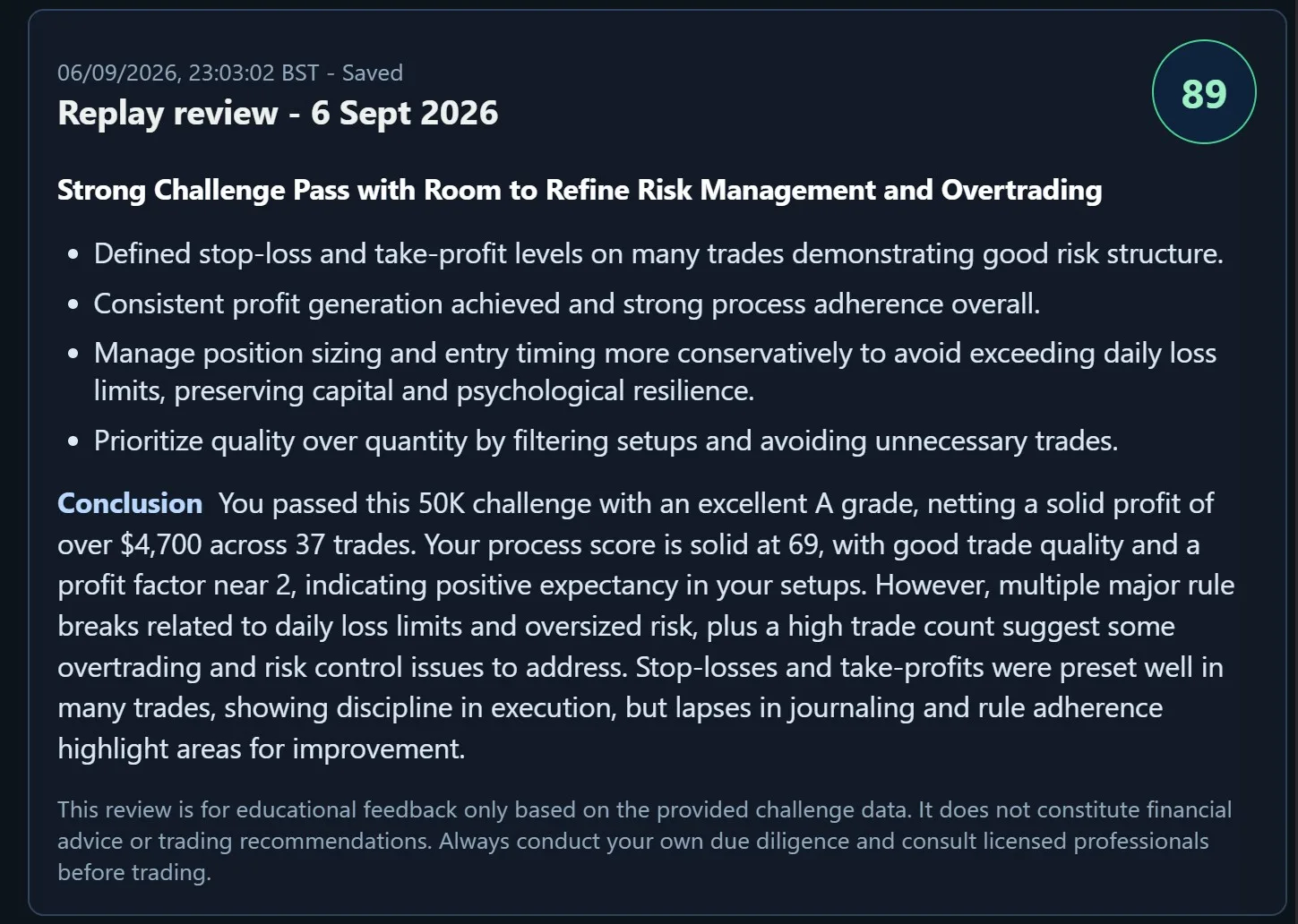
Scruffy Markets is built around the idea that simulated trading should be more structured than simply opening a demo account and trying to make fake money.
Historical futures sessions can be replayed so that you can make trading decisions without knowing what happens next. You can work within defined risk rules, place simulated trades and then review what happened afterwards.
That review is where much of the value comes from.
Did you follow the setup you said you were going to trade? Did you respect your risk? Did you overtrade? Did you move your stop? Did your behaviour change after a losing trade?
A profitable session may still contain poor decisions, while a losing session may show excellent discipline.
The aim is to understand the difference.
A Simple Paper-Trading Routine
A straightforward routine is usually better than trying to practise everything at once.
Choose one market, one session and one setup. Use the same position size on every trade, set a maximum number of trades and decide when you are going to stop for the day.
Then trade the session normally.
When it is finished, review every decision and ask whether the trade followed the rules you set beforehand.
If the account finished down but you followed your process properly, the session may still have been useful.
If the account finished up but you ignored your plan, do not pretend the session was a success.
That distinction is exactly what practice is supposed to teach you.
Paper Trading Futures FAQs
Can you paper trade futures for free?
Some platforms offer simulated futures trading or demo environments, although the available markets, historical data and features vary between providers.
Is futures paper trading realistic?
Paper trading can reproduce many parts of the trading process, including market movement, entries, exits and risk management. It cannot perfectly reproduce the psychological pressure associated with risking real money.
Is paper trading good for beginners?
Yes. It can be a useful way to learn how futures contracts, order types, stops, targets and position sizing work before introducing real financial risk.
How long should you paper trade futures?
There is no fixed period. The more important question is whether you can follow a defined process consistently and understand what your results are telling you.
Is market replay the same as paper trading?
Not exactly. Paper trading normally follows the current market, while market replay uses historical data to recreate previous trading sessions.
Should you paper trade before going live?
Simulation can help expose problems with your strategy, execution and risk management before real capital is involved. It does not guarantee that you will behave identically once real money is at risk.
Treat Simulation Like Training
Paper trading is sometimes dismissed because the money is not real, but that misses the point.
The money does not have to be real for the practice to be useful.
You can still learn to wait for a setup, follow your rules, manage risk and recognise the point where frustration starts affecting your decisions. You can discover whether your strategy is clearly defined or whether you are still changing it every time a trade goes against you.
The key is to stop treating the simulated account like a game.
Give the session a purpose, trade within clear boundaries and review what happened afterwards. Over time, the question becomes less about how much virtual money you made and much more about whether you traded the way you intended to.
That is a far more useful thing to know before real money is on the line.
Scruffy Markets lets you practise futures trading using historical market replay, simulated execution and post-session review, giving you somewhere to work on your process before putting real capital at risk.