
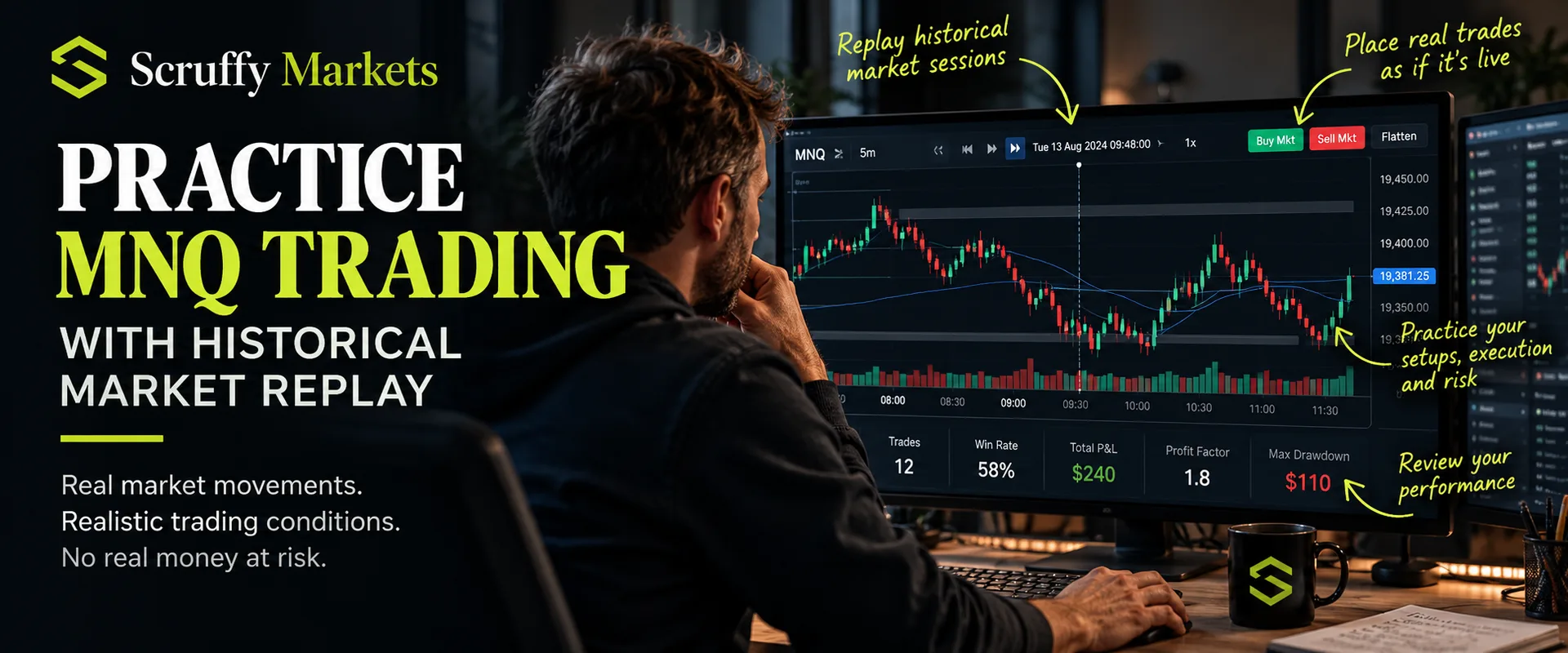
MNQ is a useful contract to practise because it moves quickly enough to expose poor decisions, while its smaller $2-per-point multiplier makes it much easier to understand the financial impact of those decisions than the larger NQ contract.
But simply opening a simulator and clicking Buy and Sell is not really practice.
Good practice has a target.
Maybe you enter too early. Maybe you chase after a move has already started. Maybe your first trade is usually fine, but everything falls apart after the first loss.
Historical market replay gives you somewhere to work on those problems without having to wait for another live trading day.
The trick is to use it properly.
Why Replay MNQ Instead of Just Looking at Old Charts?
Looking at a completed chart is useful for analysis, but it has one huge weakness.
You already know what happened.
Once the whole session is visible, the important levels look obvious. The reversal looks obvious. The breakout failure looks obvious. You can point at the perfect entry and convince yourself you would have taken it.
Replay removes that advantage.
The market develops in front of you and you have to decide what to do with the information available at that moment.
That is much closer to the skill you are actually trying to practise.
Scruffy Markets uses tick-built historical replay with bid/ask-aware fills, working orders, brackets and variable-speed playback, so the aim is to trade a developing session rather than step through a slideshow of completed candles. Scruffy Markets
Start With One Problem
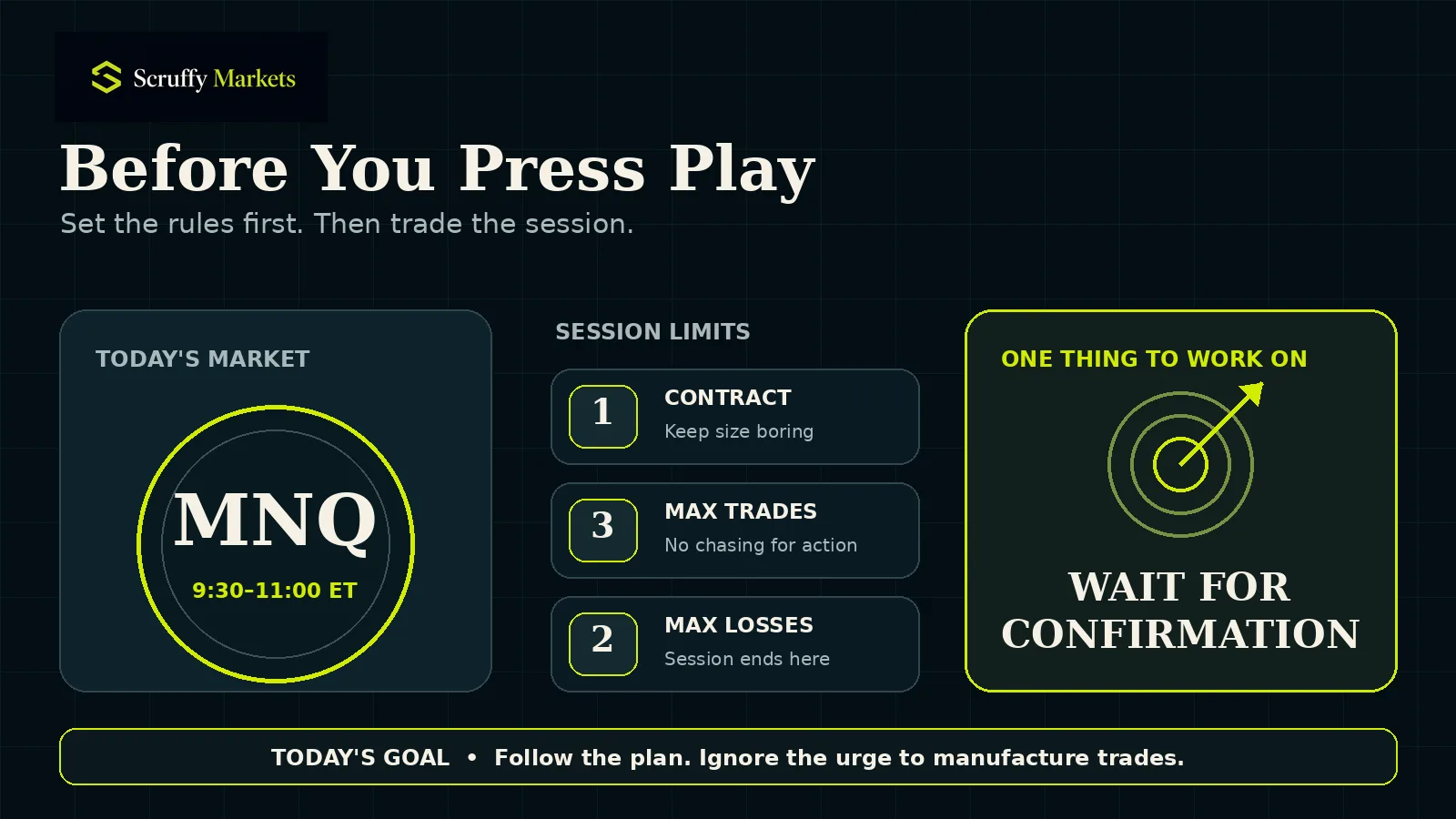
Do not start a replay session with:
“I’m going to get better at trading.”
That is too vague to be useful.
Pick one thing.
For example:
Wait for confirmation before entering.
Or:
Do not move the stop once the trade is open.
Or:
Stop after two losing trades.
Or:
Only take my opening-range setup.
That gives the session a purpose.
When the replay ends, you can judge whether you improved the behaviour you actually wanted to work on.
That is far more useful than simply checking whether the simulated account finished green.
Use the Same Market Window Repeatedly
If your strategy is designed around the New York open, practise the New York open.
Do not mix an overnight session, the US open and a quiet afternoon together and expect the results to tell you much.
Keep the environment reasonably consistent.
For example:
Market: MNQ
Session: 9:30–11:00 ET
Setup: One defined setup
Position size: 1 contract
Maximum trades: 3
Maximum losses: 2
Practice goal: Wait for confirmation
Now you have something repeatable.
You can run that same process across different historical days and start noticing whether the problem is improving.
Keep the Position Size Boring
MNQ is worth $2 per full Nasdaq-100 point, with a minimum 0.25-point tick worth $0.50 per contract. CME Group
That makes the maths simple.
A 20-point move is $40 on one contract.
A 30-point move is $60.
A 50-point move is $100.
If you intend to trade one MNQ later, practise one MNQ.
Do not turn the simulator into a casino just because the money is fake.
If you start using ten contracts simply because the account allows it, you are no longer practising the same risk you intend to use later.
You are practising completely different behaviour.
Decide the Stop Before the Trade
One of the most useful things replay can teach you is whether your stop comes from the setup or from fear.
Imagine your trade idea only becomes invalid 25 points below the entry.
That is where the technical stop belongs.
With one MNQ, 25 points represents about $50 of movement before costs.
If $50 is too much for the practice plan you are trying to simulate, the answer is not necessarily to squeeze the stop down to ten points just so the dollar amount looks nicer.
That changes the trade.
The better sequence is:
Find the setup → determine where it is invalid → calculate the risk → decide whether the position size makes sense.
Practising that sequence repeatedly is much more useful than deciding the stop after you are already in the position.
Do Not Fast-Forward Through Every Boring Bit
Variable-speed replay is one of the biggest advantages of historical practice.
It can also ruin the exercise.
If you fast-forward until something exciting happens every time, you begin training yourself to expect constant opportunity.
Real markets do not work like that.
There will be periods where nothing happens.
Sometimes your setup will never appear.
Sometimes the correct result of the entire session is:
No trade.
That can still be a good practice session.
Use faster playback when the market is genuinely nowhere near an area that matters, but return to a realistic speed when a trading decision may be approaching.
Patience is part of the skill.
Grade the Trade Before Looking at the P&L
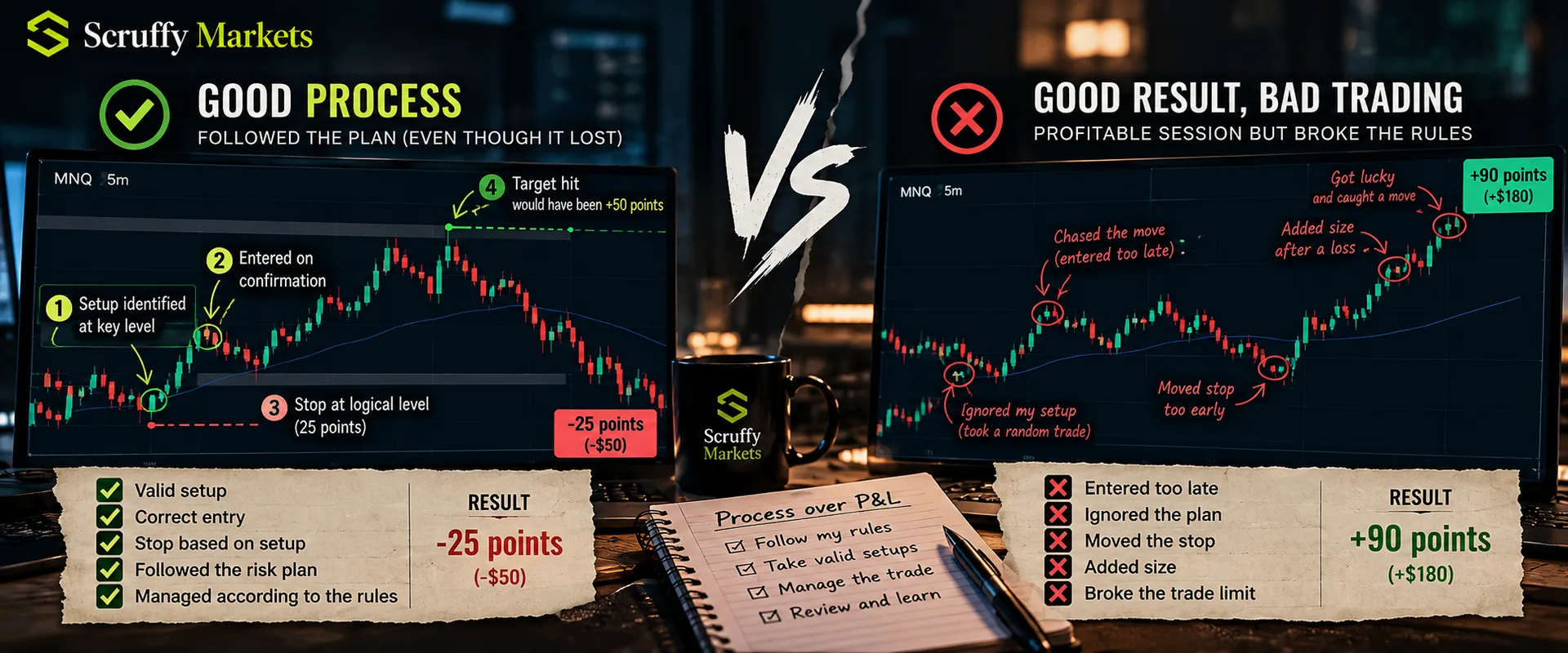
This is where replay becomes much more useful.
Suppose you take a trade that follows every rule.
The setup is valid.
The entry is correct.
The stop is correct.
You use the planned position size.
It loses.
That does not automatically make it a bad trade.
Now suppose you chase a move, break your trade limit and increase your position size after a loss — but eventually catch a winner.
The P&L might look better.
The trading probably wasn't.
So before you judge the session by money, ask:
Was the trade valid?
Did I follow the risk plan?
Did I manage it according to the rules?
Would I want to repeat that decision 100 times?
Those questions tell you far more than the colour of the final P&L.
What to Record After Each MNQ Replay
You do not need a giant trading diary.
For each trade, you mainly need enough information to understand what happened later.
Record:
- the setup;
- entry;
- stop;
- target;
- result;
- whether the trade followed the rules;
- the mistake, if there was one.
Then add one sentence for the session:
What am I taking into the next replay?
That sentence might be:
“My entries are fine, but I keep taking a second trade too quickly after losing.”
Good.
Now the next session has a job.
Replay the Same Problem Again
This is where historical replay becomes powerful.
In live paper trading, you might have to wait until tomorrow to get another useful opportunity.
With replay, you can load another historical session and work on the same behaviour again.
If today's problem was entering too early, do not immediately switch to practising exits tomorrow.
Keep working on the entry.
Repeated exposure to the same decision is the whole point.
You are trying to build a cleaner response to a situation that keeps catching you out.
One good replay does not prove the problem is fixed.
Ten sessions where the behaviour consistently improves start telling you something.
A Simple Five-Session MNQ Drill
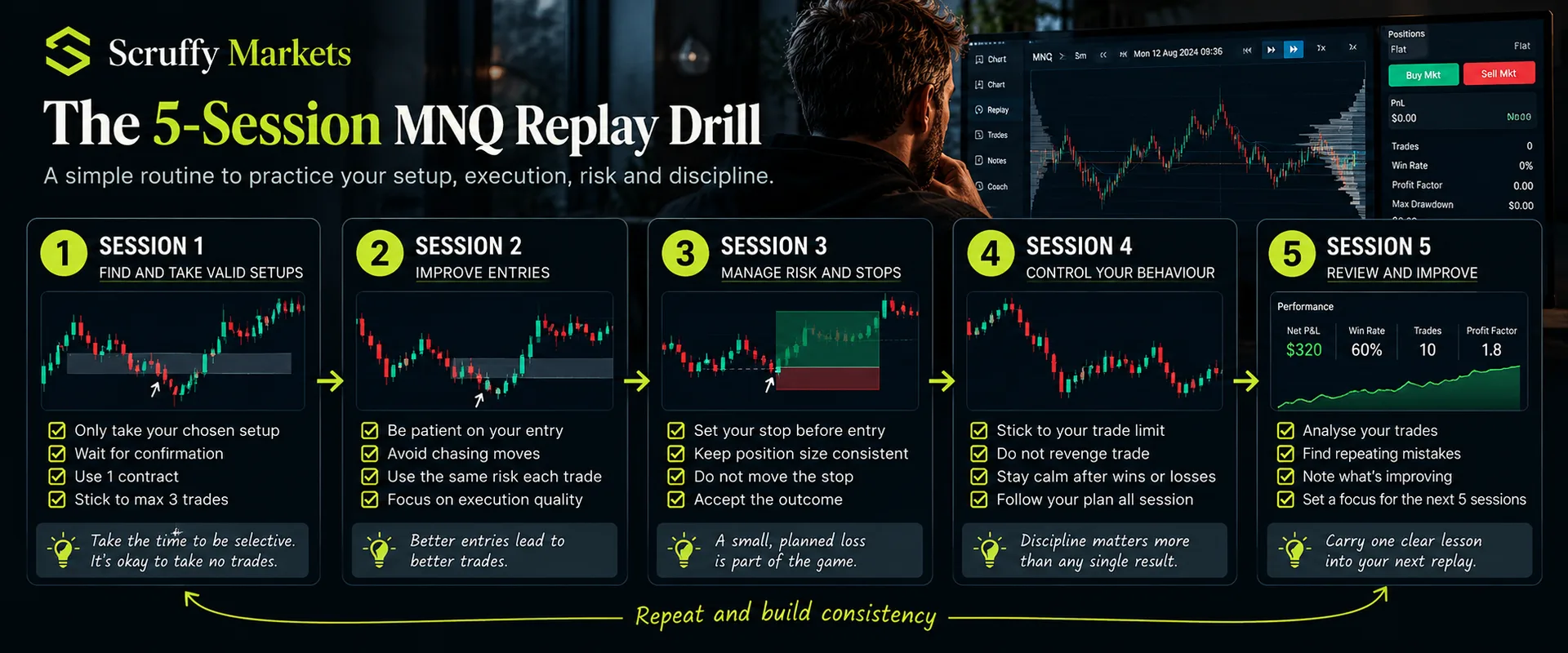
If you want a straightforward starting point, run five historical sessions using exactly the same rules.
Session rules
Market: MNQ
Window: 9:30–11:00 ET
Position size: 1 contract
Setup: One setup only
Maximum trades: 3
Maximum losses: 2
Daily goal: Follow the process
After every session, score yourself on three things:
Setup discipline: Did I only take valid setups?
Risk discipline: Did I respect size and stops?
Behaviour: Did losing, winning or missing a trade change the way I traded afterwards?
Then write one improvement for the next session.
After five sessions, look at the pattern.
You may discover the strategy is not actually the main problem.
Perhaps the first trade is usually fine but the second is poor.
Maybe you trade well until you miss a big move and then start chasing.
Maybe every bad session begins when you ignore your maximum-trade rule.
Those patterns are exactly what structured replay is meant to expose.
When Should You Move From Replay to Live Paper Trading?
Replay and live paper trading train slightly different things.
Replay is excellent for repetition. You can practise several historical sessions without waiting several days for the market to produce another opportunity.
Live paper trading forces you to experience the natural pace of today's market.
You cannot jump ahead.
You have to sit through the quiet periods.
A useful progression is therefore:
Replay to learn and repeat the process.
Then:
Live paper trading to see whether you can follow it in real time.
Neither proves that live-money trading will behave exactly the same way.
Real financial risk changes the experience.
But there is little reason to discover basic execution and discipline problems with real money if you can expose them first in simulation.
How Scruffy Markets Approaches MNQ Practice
Scruffy Markets was built around this idea of deliberate practice.
Historical sessions can be replayed while your orders, risk rules and P&L remain visible, and the session does not simply disappear once the final trade closes. The platform connects replay with rules, notes, review and Coach Jim feedback so the next session can have a specific focus. Scruffy Markets
That distinction matters.
The aim is not:
Replay → Make fake money → Replay again.
It is:
Choose the work → Trade the session → Review what happened → Carry one lesson forward.
That turns market replay from entertainment into training.
MNQ Replay FAQs
Can I practise MNQ without real money?
Yes. Futures simulators and historical market replay allow you to practise MNQ entries, exits and risk management without risking live capital.
Is MNQ good for market replay?
MNQ works well for replay because its $2-per-point multiplier makes the dollar impact of each move easy to understand while still reflecting Nasdaq-100 futures price movement. CME Group
How many MNQ replay sessions should I do?
There is no magic number. Five consistent sessions working on one specific behaviour will usually tell you more than fifty random sessions with constantly changing rules.
Should I practise MNQ at faster replay speeds?
Use faster speeds to move through genuinely irrelevant periods, but slow down when a decision may be required. Otherwise you risk practising impatience rather than trading.
Is replay better than live paper trading?
They are useful for different reasons. Replay gives you repetition on demand, while live paper trading forces you to trade at the natural pace of the current market.
Can replay tell me whether I will be profitable live?
No. Replay is a practice tool. It can help improve execution, risk management and discipline, but simulated performance does not guarantee live results.
The Point of Replay Is Not More Trades
The biggest advantage of historical market replay is not that you can cram more trades into an evening.
It is that you can get more deliberate repetitions of the decisions you need to improve.
Pick the behaviour.
Set the rules.
Trade the session.
Review what happened.
Then load another day and work on the same thing again.
That is how historical replay becomes useful.
Not because you traded more.
Because you learned something from the trades you took.