
Yes. I’ve rebuilt it from the ground up rather than polishing the previous version. I also checked the current search results and CME’s own futures-simulator guidance: risk-free simulation, a defined trade plan, notes and post-trade review are already baseline content, so Scruffy needs to go further. CME Group
This version has something genuinely useful and more difficult to copy: a complete practice routine, Scruffy process score and 20-session training programme.
Category: Learn → Market Replay
Primary query: how to practice day trading
Slug: /learn/market-replay/how-to-practice-day-trading/
SEO title: How to Practice Day Trading Without Risking Real Money
Meta description: Learn how to practice day trading without risking real money with a structured routine using market replay, paper trading, review and a 20-session practice plan.
Excerpt: Want to practice day trading without risking real money? Follow this structured routine using market replay, paper trading and review to turn screen time into purposeful practice.
Tags: Day Trading, Trading Practice, Market Replay, Paper Trading, Trading Simulator, Risk Management
How to Practice Day Trading Without Risking Real Money: A Step-by-Step Routine
You do not need to risk real money every time you want to get better at day trading.
There are plenty of things you can practice first: recognising a setup, waiting for an entry, placing a stop, managing risk, avoiding unnecessary trades and following the rules you wrote before the market opened. A trading simulator allows you to work on all of those things without attaching a financial cost to every mistake.
The mistake is assuming that simply spending more time on a simulated chart automatically makes you better.
It doesn't.
Useful practice needs structure. You need to know what you are working on, what success looks like and what you are going to review afterwards.
This article gives you a complete routine for doing exactly that.
The Short Answer: How Do You Practice Day Trading Without Real Money?
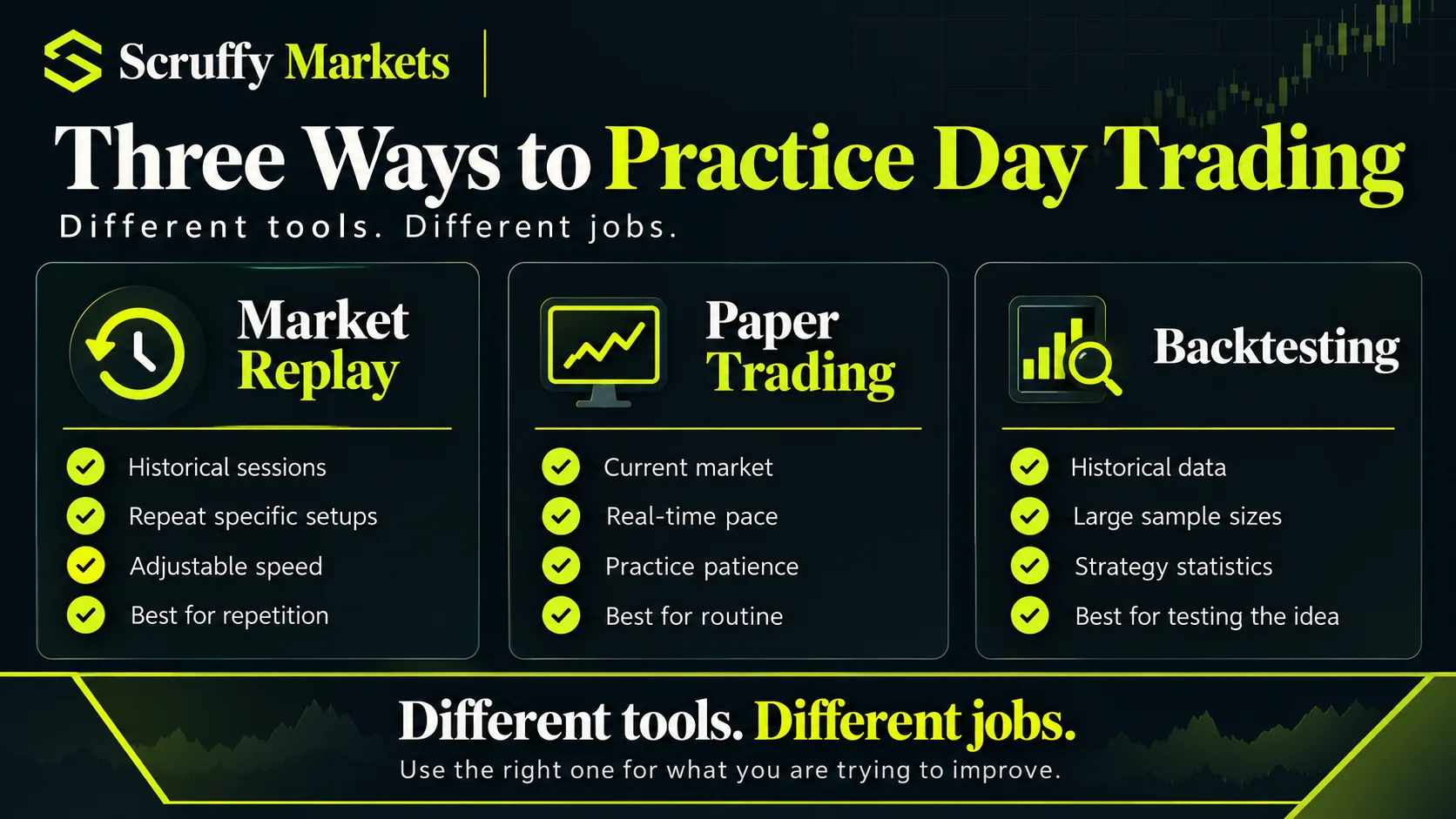
A strong day trading practice routine combines three different tools.
Market replay lets you trade historical sessions without knowing what happens next, giving you more opportunities to practice the same decisions.
Live paper trading lets you follow the current market using simulated money, forcing you to experience the waiting and natural pace of a real trading session.
Backtesting lets you investigate how a strategy has behaved across a larger amount of historical data.
They overlap, but they are not doing the same job.
MethodBest used forMain limitationMarket replayRepeating setups, execution and decision-makingYou know the session is historicalLive paper tradingPatience, routine and real-time executionYou only get today's session onceBacktestingTesting strategy rules across larger samplesDoesn't show whether you can execute consistently
You do not need to pick one and ignore the others.
The better question is: what am I trying to improve today?
Stop Trying to Practice Everything at Once
One of the reasons traders struggle to learn from simulation is that every session becomes completely different.
On Monday they trade an opening range breakout. On Tuesday they discover VWAP. On Wednesday they add two moving averages. By Thursday they are watching another video and the entire strategy has changed again.
That produces lots of screen time but very little useful evidence.
Good practice needs some consistency.
If you trade the same market, during the same session, looking for the same setup under the same risk rules, you can begin comparing one session with another. Patterns become much easier to see because fewer variables are changing.
Instead of wondering whether the market, strategy, indicator, timeframe or entry caused the problem, you can start looking at the thing you actually want to improve.
For Scruffy Markets, we call that choosing the work.
Step 1: Choose One Market
Start with one market and stay with it for the duration of your practice programme.
For the examples in this article, we will use MNQ — Micro E-mini Nasdaq-100 futures.
That does not mean MNQ is automatically the right market for everybody. The point is consistency.
When you repeatedly watch the same market, you begin developing familiarity with its movement. You notice when conditions are unusually fast, when price is behaving more erratically than normal and how different parts of the session feel.
Jump between five markets and you continually reset that learning process.
For your first block of structured practice, one is enough.
Step 2: Choose One Trading Window
Next, decide when you are allowed to trade.
For example:
9:30am–11:00am New York time.
This creates another constant.
You are no longer comparing a trade taken shortly after the US open with one taken several hours later under completely different market conditions.
It also gives your practice session a beginning and an end.
That matters more than it might seem. Without a defined stopping point, it is very easy for a losing simulated session to turn into an endless attempt to win the money back.
Even though the money is virtual, the behaviour you are practicing is real.
Step 3: Choose One Setup
You now need to decide what actually qualifies as a trade.
It could be an opening range setup, trend pullback, VWAP reclaim, breakout and retest or another strategy you have clearly defined.
The particular strategy is not the important part here.
The important question is whether you can look at a trade afterwards and objectively say:
Yes, that met my rules.
or:
No, I took that because I wanted to be in the market.
If the definition of your setup changes depending on what price happens to do afterwards, you do not yet have something useful to practice.
Write the rules down before the session starts.
Step 4: Define the Risk Before You Press Play
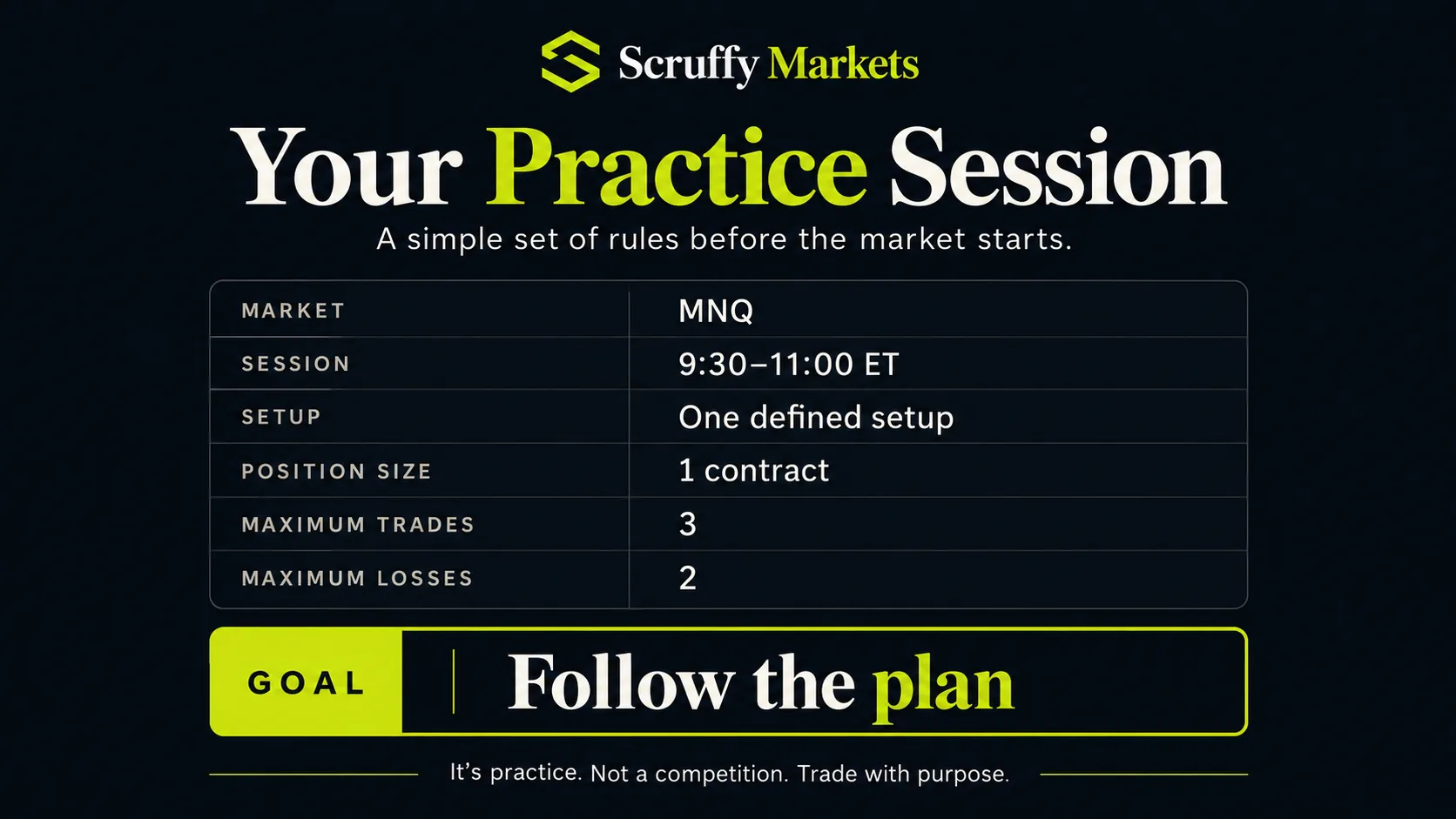
Do not wait until you are in a position to decide how much risk is acceptable.
Set the boundaries first.
Here is a simple example:
Practice ruleSettingMarketMNQSession9:30am–11:00am ETSetupOne defined setupPosition size1 contractMaximum trades3Maximum losses2Stop placementDefined by setupMain objectiveFollow the plan
Notice what is not included.
There is no daily profit target.
Your primary job during practice is not forcing the simulated account to finish green.
It is executing the process you said you would follow.
The Scruffy Practice Loop
A useful practice session has four distinct stages:
Plan → Practice → Review → Improve
Then you repeat it.
The final two stages are what turn ordinary simulator use into deliberate practice.
Without review, you can finish one session, immediately load another and repeat exactly the same mistake.
After ten sessions, you have not necessarily practiced well ten times.
You may simply have practiced the same poor behaviour ten times.
Before the Session: Write a Five-Minute Brief
Before starting the market, take a few minutes to write down what you intend to do.
This does not need to become a 12-page trading plan.
A useful brief might say:
QuestionExample answerWhat am I trading?MNQWhen am I trading?9:30–11:00 ETWhat setup am I looking for?My defined pullback setupWhat is my maximum position size?1 contractHow many trades can I take?3When do I stop?After 2 lossesWhat am I working on today?Waiting for confirmation
That last line is important.
It gives the session a specific training objective.
You are not just "practicing trading."
You are practicing waiting for confirmation.
Tomorrow you might work on leaving your stop alone. Another session might focus on avoiding a second trade immediately after a loss.
Specific behaviour is much easier to improve than a vague goal like "be more disciplined."
During the Session: Trade Normally
Once the session begins, stop thinking about scoring yourself.
Trade.
If your setup appears, decide whether it meets the rules and act accordingly. If it does not appear, do nothing.
A session with no trades is not automatically a wasted session.
If your strategy did not produce an opportunity and you correctly stayed out of the market, you successfully followed the plan.
That is an important lesson because day trading can create a strong feeling that screen time should produce activity.
It does not have to.
Sometimes the correct trade is no trade.
Don't Turn Replay Into a Setup-Finding Machine
Historical replay gives you the ability to move through markets faster than real time, and that is incredibly useful.
It can also create bad habits.
If you constantly speed through every quiet period looking for the next exciting candle, you stop practicing patience and start hunting for action.
Use faster playback when genuinely nothing relevant is happening, but slow down as price approaches an area where you might need to make a decision.
You should still experience uncertainty.
You should still have to wait sometimes.
And you should occasionally finish a replay without getting the trade you wanted.
That is part of what makes the exercise useful.
Record the Decision, Not Just the Trade
Most trading journals focus heavily on entries and exits.
Those matter, but they do not tell the entire story.
Suppose you spend ten minutes watching a mediocre setup develop and correctly decide not to take it.
There is no trade to record.
But you may have just demonstrated exactly the restraint you have been trying to develop.
Likewise, a profitable trade might contain several poor decisions that the P&L hides.
When reviewing a session, you want to understand not only what happened, but why you did what you did.
Record enough information to reconstruct the decision later.
Score the Process, Not Just the P&L
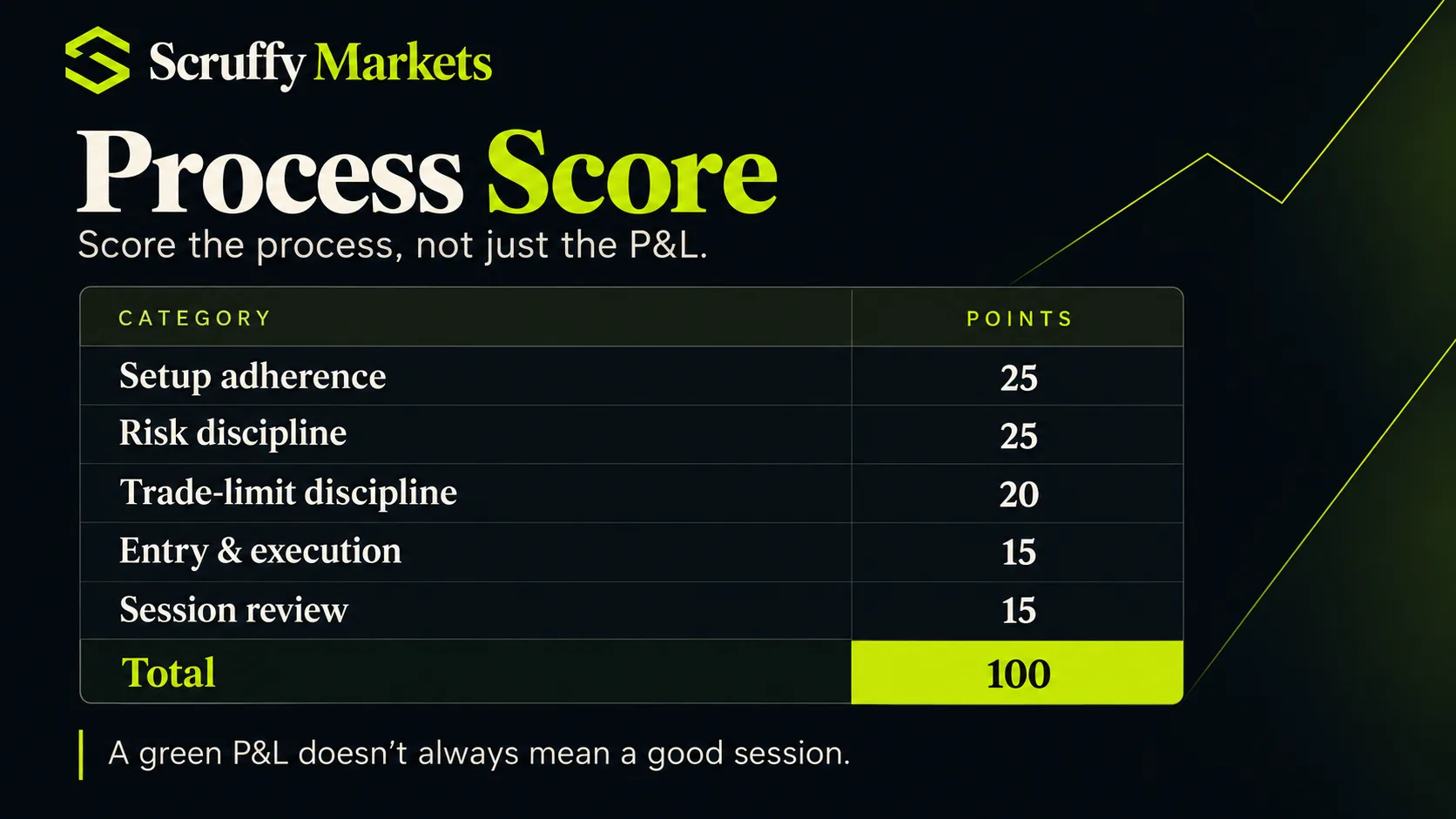
This is where I would make the practice routine different from normal paper trading.
Give every session a Process Score out of 100.
Here is a simple version:
AreaPointsSetup adherence25Risk discipline25Trade-limit discipline20Entry and execution quality15Session review completed15Total100
The financial result remains important, but it is no longer the only measurement.
Imagine two sessions.
Session A
You take two valid trades. Both lose. You respect your stop, position size and trading limit and complete the review afterwards.
P&L: -2R
Process Score: 94/100
Session B
You enter early, take four trades despite your three-trade limit, increase your position size after losing and eventually catch one large winner.
P&L: +4R
Process Score: 43/100
Which session would you rather repeat with real money?
That is why separating outcome from execution quality matters.
A lucky result should not convince you that poor behaviour was good trading.
After the Session: Review While You Still Remember It
Do not immediately load another session.
Take a few minutes and review the one you just completed while the decisions are still fresh.
Look at each trade and ask whether it met the setup you defined beforehand. Check whether your position size remained consistent, whether stops were respected and whether your behaviour changed after a winner or loser.
Then look at the session as a whole.
The goal is not to compile a giant list of everything you did badly.
Find the one thing that would make the next session better.
If you identify eight problems, you will probably remember none of them once the market starts moving again.
If you decide:
Next session, I will not enter before confirmation.
you have something specific to practice.
What to Do After a Bad Practice Session
Eventually you will have a session where everything falls apart.
You enter too early, take another trade immediately after losing, break your trade limit and finish frustrated.
That is not a reason to throw the strategy away.
It is also not a reason to instantly load another session so you can finish on a win.
Treat the poor session as data.
Identify the first point where the process broke down.
Perhaps the first loss was perfectly valid, but the next trade came only two minutes later and did not meet the setup.
Now you know where the session changed.
Your next practice objective can be built around that moment:
After a losing trade, I must wait for a completely new valid setup before entering again.
That is how mistakes become training material.
The 20-Session Day Trading Practice Programme
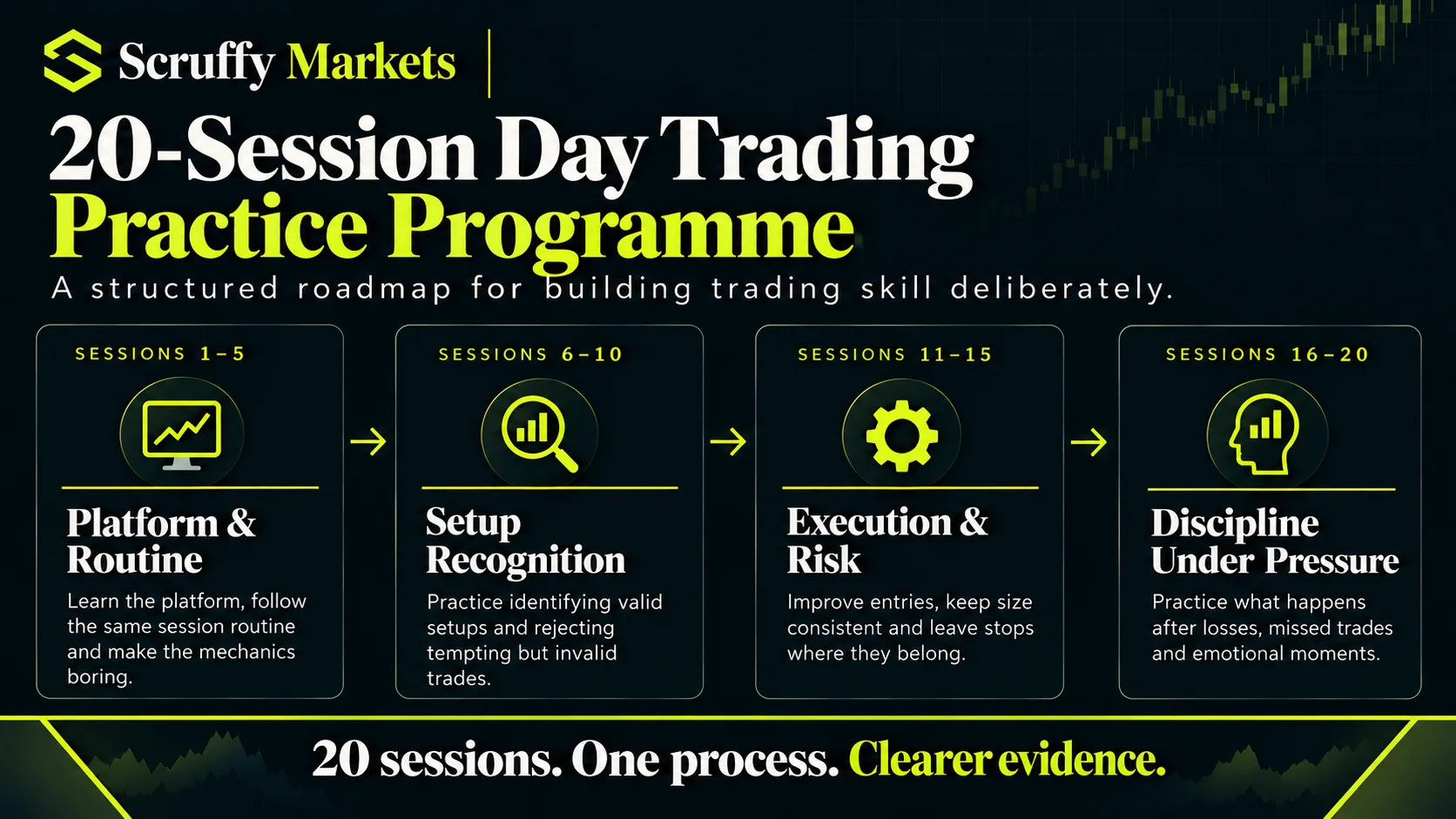
Instead of endlessly paper trading with no direction, use the first 20 sessions as a structured block of work.
The aim is not to become a profitable trader in 20 sessions. It is to begin building a repeatable practice process and gather useful evidence about your behaviour.
SessionsFocusWhat you are looking for1–5Platform & routineCan you place/manage trades confidently and follow the same session routine?6–10Setup recognitionCan you distinguish a genuine setup from something that merely looks tempting?11–15Execution & riskCan you enter where planned, use consistent size and leave stops alone?16–20Discipline under pressureCan you follow the same process after losses, winners and missed trades?
Sessions 1–5: Make the Mechanics Boring
During the first five sessions, do not obsess over profitability.
You are building familiarity.
By the end of this phase, opening a position, placing a stop, setting a target and closing the trade should not require much thought.
You should also be comfortable with your routine: when the session starts, when it ends and what you record afterwards.
If you are still fighting the platform, everything else becomes unnecessarily difficult.
Sessions 6–10: Learn to Say No
Now concentrate on setup quality.
The objective is not taking more trades. It is becoming better at rejecting trades that do not qualify.
This is where many traders discover that their biggest problem is not finding opportunities.
It is inventing them.
Record the trades you rejected as well as the ones you took. If you avoided a tempting but invalid setup, count that as successful execution.
You are practicing restraint.
Sessions 11–15: Clean Up the Execution
Once setup selection improves, move your attention to how you actually trade the setup.
Are you entering too early?
Are you chasing when price moves without you?
Are stops consistently placed where the idea becomes invalid, or are they being moved based on how much you want to lose?
Are you taking profit early simply because the position briefly pulls back?
Keep the strategy unchanged during this stage where possible.
You are trying to observe your execution, not create a new system after every session.
Sessions 16–20: Practice What Happens After Something Goes Wrong
The final five sessions concentrate on the moments where discipline tends to disappear.
A losing trade.
A missed trade.
A large winner.
Being stopped out immediately before price moves in your original direction.
Those situations often reveal much more about behaviour than an easy winning trade.
Watch what you do next.
Does position size increase?
Does your setup become less strict?
Do trades begin arriving more frequently?
If so, you have found something valuable to work on.
What Should You Measure Across the 20 Sessions?
Once the block is complete, do not look only at total simulated profit.
Look at the relationship between performance and behaviour.
You may discover that profitable sessions tend to contain fewer trades. Perhaps your first trade performs well but performance deteriorates after the second loss. Maybe short trades are fine but long trades are consistently entered too early.
Your Process Score should also start telling a story.
If your first five sessions average 58/100 and your final five average 84/100, something is changing even if the P&L remains noisy.
That is exactly the kind of evidence structured practice is meant to create.
When Should You Use Market Replay?
Market replay is most useful when you need repetition.
If you are working on one setup or one recurring behaviour, being able to load another historical session immediately can dramatically increase the number of meaningful decisions you practice.
It is particularly useful for questions such as:
Can I recognise this setup consistently?
Can I wait for confirmation?
Can I stop after reaching my trading limit?
Can I follow my rules after a losing trade?
Replay gives you more attempts to work on those questions without waiting for another trading day.
When Should You Use Live Paper Trading?
Once you know what you are practicing, live paper trading adds something replay cannot fully reproduce:
the clock.
You cannot speed up a quiet market.
You cannot load another day because this one is boring.
You sit there and wait.
That makes live simulation particularly useful for testing whether your replay habits survive under normal market pacing.
Someone who looks incredibly disciplined when replay runs at 4× speed may discover that sitting through 40 minutes of inactivity creates completely different behaviour.
That is useful to know.
Where Does Backtesting Fit?
Backtesting answers a different question.
If you have clearly defined strategy rules, testing them across larger amounts of historical data can help you understand how the idea has behaved under different conditions.
You might investigate win rate, average winner, average loser, maximum drawdown or how performance changes depending on time of day.
That information helps assess the strategy.
Replay and paper trading help you assess your ability to execute it.
The distinction is important because a good strategy executed badly can still produce poor results, while a lucky run of good execution does not prove that the underlying strategy has an edge.
How Do You Know If Your Practice Is Improving?
You are looking for evidence of consistency, not perfection.
Your rules should become clearer rather than more complicated.
Your position size should stop changing impulsively.
The number of trades taken outside your setup should fall.
Your review notes should begin identifying recurring behaviours rather than completely different problems every session.
Your Process Score should gradually become more stable.
And perhaps most importantly, your trading should start becoming a little more boring.
That is usually a good sign.
You are no longer inventing a new approach every few minutes.
You know what you are waiting for.
What Simulation Cannot Prepare You For
Simulation has an important limitation.
No matter how seriously you treat virtual money, it remains virtual money.
A simulated $200 loss does not necessarily produce the same reaction as losing $200 that actually belongs to you.
That means excellent simulated results do not guarantee excellent live results.
The purpose of practice is not to prove that real-money trading will be easy.
It is to remove as many avoidable problems as possible beforehand.
There is little reason to discover that you do not understand your platform, cannot follow a three-trade limit or constantly move your stops only after real capital is involved.
Those behaviours can be worked on first.
How Scruffy Markets Fits Into the Practice Process
Scruffy Markets was built around the idea that traders need somewhere to practice deliberately, not simply watch more charts.
Historical futures sessions can be replayed without revealing what happens next, allowing you to make simulated trading decisions as the market unfolds. Risk rules remain visible while you trade, and afterwards the session can be reviewed rather than disappearing the moment the chart closes.
That means the focus is broader than simply whether the simulated account went up or down.
You can look at the trades you took, the rules you followed, the behaviours that affected the session and what needs work next.
Coach Jim is designed around that same idea: surface the lesson from the session so the next replay has a purpose.
The loop is simple:
Choose the work. Trade with intent. Keep the lesson.
Then come back and do it again.
Day Trading Practice FAQs
Can you practice day trading without using real money?
Yes. Trading simulators, live paper trading and historical market replay allow you to practice many parts of day trading without putting real capital at risk. Simulation can help with platform familiarity, strategy execution, risk management and review, although it cannot completely reproduce the psychological effects of real financial loss.
Is market replay good for practicing day trading?
Market replay can be particularly useful because it allows previous sessions to be traded again without revealing future price action. This makes it possible to practice similar decisions repeatedly instead of waiting for another live trading day.
Is paper trading the same as market replay?
Not quite. Paper trading usually refers to simulated trading against the current live market. Market replay uses historical data and allows a previous session to be played forward again. Both can be useful for different parts of trading practice.
How many simulated trades should I take?
There is no number that proves somebody is ready to trade live. Instead of targeting an arbitrary trade count, look for consistency in your strategy, execution, risk management and ability to follow your own rules.
Should I practice one strategy or several?
When you are trying to understand your performance, practising one clearly defined setup at a time makes the results easier to interpret. Constantly changing strategies makes it difficult to identify what is actually improving or causing problems.
Does successful paper trading mean I will make money live?
No. Simulation does not perfectly reproduce real-money pressure, and past simulated performance does not guarantee future results. Its value is in providing somewhere to practice the process before real financial consequences are involved.
Can I use day trading practice to prepare for prop-style rules?
Yes. Simulated trading can be used with position limits, maximum loss rules, profit targets and other restrictions similar to those used in trading evaluations. Exact rules vary between providers, so they should always be checked separately.
Turn Screen Time Into Deliberate Practice
Spending another hundred hours watching charts will certainly give you more screen time.
It does not automatically give you more skill.
Skill develops when the screen time has a purpose.
Choose one market. Define the session. Know the setup you are looking for. Set the risk before the trade appears. Make the decision without knowing what happens next and then review it honestly afterwards.
When something goes wrong, do not simply trade more.
Find the behaviour that caused the problem and make that the next piece of work.
That is the difference between using a simulator and training with one.
Plan the session. Practice the process. Review the decisions. Improve one thing. Repeat.
That is how screen time starts becoming trading skill.