
If you have started looking at futures trading, it probably won't take long before you come across the ticker MNQ.
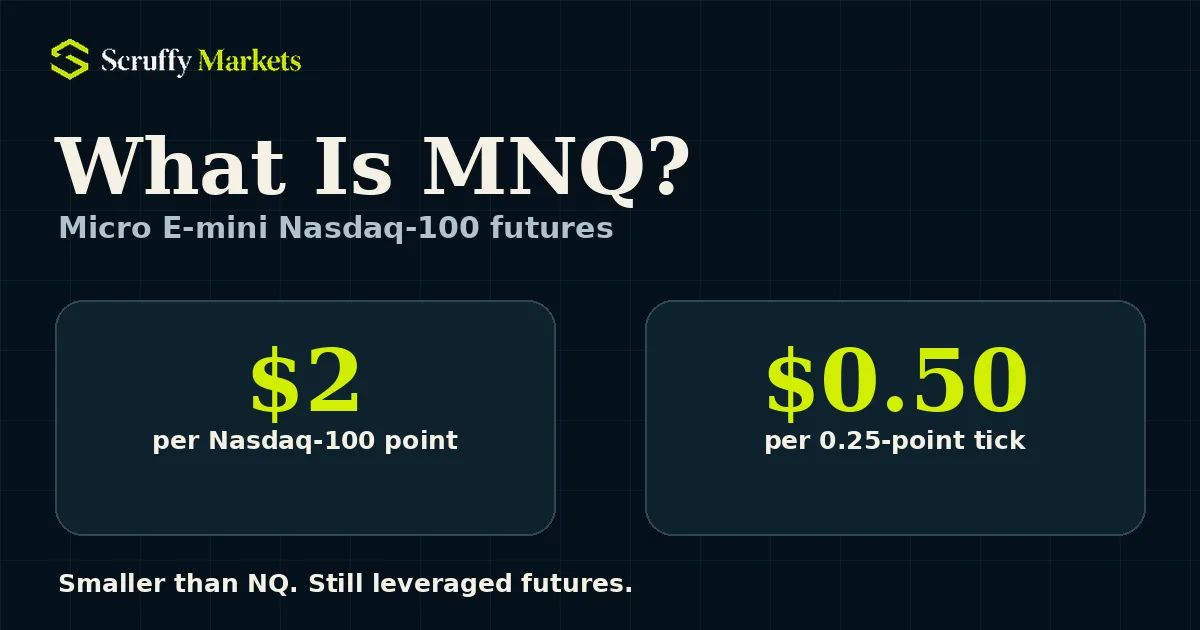
MNQ stands for Micro E-mini Nasdaq-100 futures. It is a futures contract based on the Nasdaq-100 Index and is worth $2 for every index point the market moves. The minimum price movement is 0.25 points, which means each tick is worth $0.50 per contract. CME Group
That smaller contract size is the main reason MNQ has become so useful to individual traders. It gives you exposure to Nasdaq-100 futures without attaching the $20-per-point value of the larger NQ contract to every decision.
But “Micro” does not mean harmless.
MNQ is still a leveraged futures contract, and once the Nasdaq starts moving quickly, even $2 per point can add up surprisingly fast.
So let's look at what you are actually trading.
What Exactly Is MNQ?
MNQ is a futures contract listed by CME Group that follows the Nasdaq-100 Index.
The Nasdaq-100 represents 100 leading non-financial large-cap companies and is heavily associated with major technology and growth businesses. MNQ therefore gives traders a way to take futures exposure to movements in that index rather than buying the individual shares that make it up. CME Group
You are not buying the Nasdaq.
You are not buying a share of an ETF.
And you do not own the companies inside the index.
You are trading a futures contract whose value moves in relation to the Nasdaq-100.
CME introduced the Micro E-mini equity-index contracts in May 2019. The Micro contracts were designed at one-tenth the size of their larger E-mini equivalents, which means MNQ is one-tenth the size of NQ. CME Group
MNQ at a glance
| Detail | MNQ |
|---|---|
| Full name | Micro E-mini Nasdaq-100 futures |
| Ticker | MNQ |
| Underlying index | Nasdaq-100 |
| Contract multiplier | $2 × Nasdaq-100 Index |
| Value of 1 point | $2 |
| Minimum tick | 0.25 points |
| Value of 1 tick | $0.50 |
| Size compared with NQ | One-tenth |
| Main quarterly months | March, June, September, December |
The numbers in that table are worth understanding before you go anywhere near a trade.
What Does $2 Per Point Actually Mean?
This is the simplest part of MNQ, but also one of the most important.
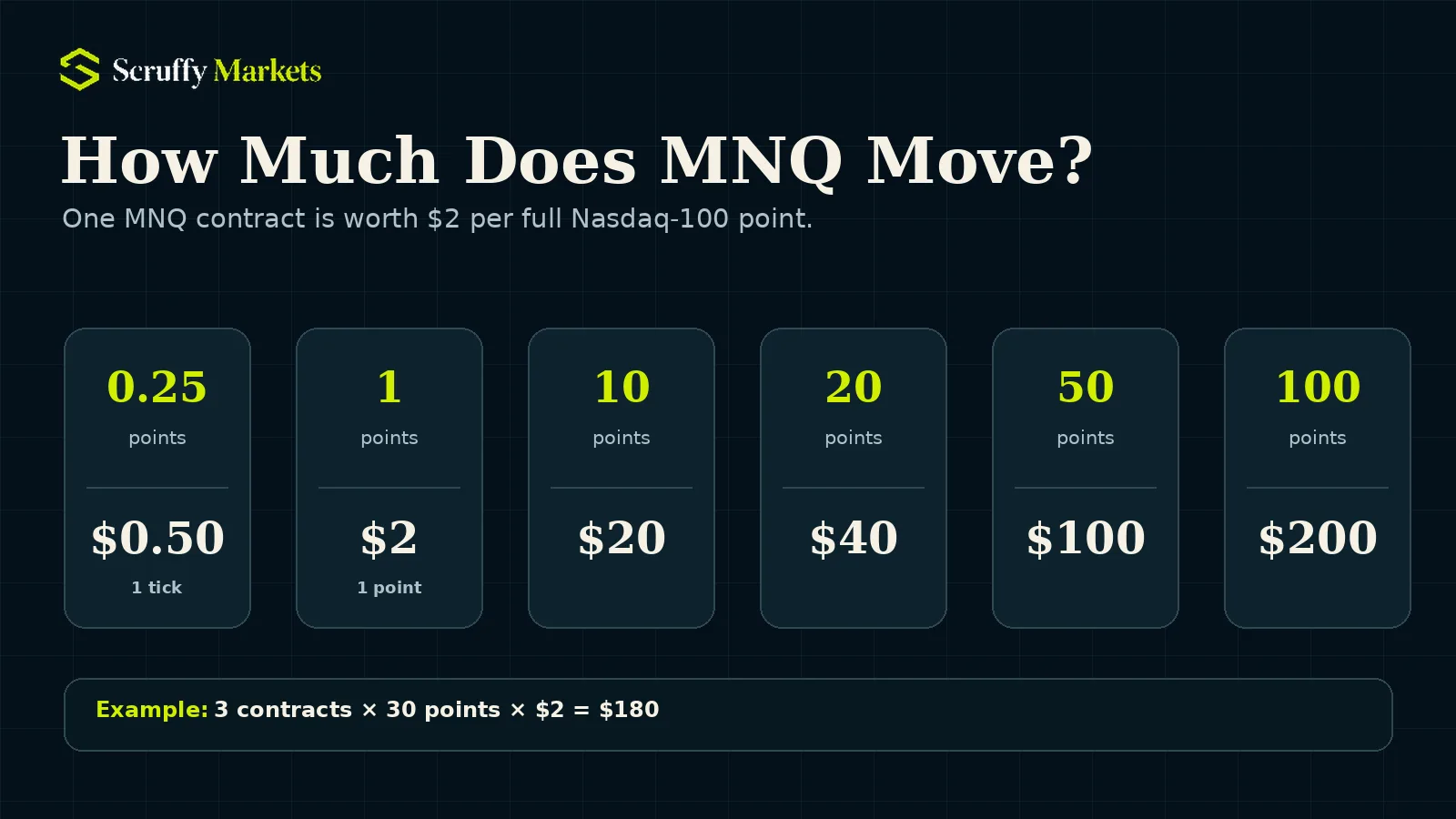
One MNQ contract moves $2 for every full Nasdaq-100 point.
If price moves one point in your favour, your position changes by $2.
Ten points means $20.
Fifty points means $100.
One hundred points means $200.
The smallest normal price increment is 0.25 points, known as one tick. Because each full point is worth $2:
0.25 × $2 = $0.50 per tick
So with one MNQ contract:
| Nasdaq move | Value per MNQ contract |
|---|---|
| 0.25 points | $0.50 |
| 1 point | $2 |
| 10 points | $20 |
| 20 points | $40 |
| 50 points | $100 |
| 100 points | $200 |
The same calculation works whether the trade is profitable or losing.
If you are long one MNQ and price falls 30 points, that movement represents a $60 loss before commissions and fees.
If you are short and price falls 30 points, it represents a $60 gain before costs.
Add another contract and the numbers double.
Three contracts moving 30 points equals:
3 × 30 × $2 = $180
This is why knowing the number of contracts matters just as much as knowing the ticker.
MNQ vs NQ
MNQ and NQ both track the Nasdaq-100, but their contract multipliers are very different.
NQ is worth $20 per point.
MNQ is worth $2 per point.
That makes one MNQ one-tenth the point-value exposure of one NQ.
So imagine your trade needs a 25-point stop.
With one MNQ:
25 × $2 = $50
With one NQ:
25 × $20 = $500
Nothing about the chart has changed.
The setup hasn't changed.
The stop hasn't changed.
Only the amount of money attached to each point has changed.
That is the real benefit of MNQ. It gives traders finer control over position size.
It does not somehow make a bad trade safe.
We've covered this in much more detail in MNQ vs NQ vs NNQ: What's the Difference?, including the new E-nano NNQ contract.
MNQ Is Not the Nasdaq Composite
This is an easy source of confusion when somebody first starts trading Nasdaq futures.
MNQ follows the Nasdaq-100 Index, not the entire Nasdaq Composite Index.
Those are not the same thing.
The Nasdaq Composite includes thousands of Nasdaq-listed companies, while the Nasdaq-100 is a much narrower benchmark built around 100 major non-financial companies.
So when traders casually say they are “trading Nasdaq” while using MNQ or NQ, what they are really trading is futures based on the Nasdaq-100.
That distinction becomes more important when you start comparing charts, news reports and other Nasdaq-related instruments.
When Does MNQ Trade?
One of the major differences between futures and ordinary US stock-market hours is how long the market is available.
CME currently lists its equity-index futures as trading from Sunday at 5:00 p.m. to Friday at 4:00 p.m. Central Time, with a daily maintenance break between 4:00 p.m. and 5:00 p.m. CT. That is equivalent to roughly 23 hours of market access on normal trading days. CME Group
That does not mean every hour behaves the same way.
The period around the US cash-market open can feel completely different from the quieter overnight session. Volume, volatility, spreads and the speed of price movement can all change throughout the day.
That matters if you are practicing a strategy.
A setup that you normally trade around the New York open should ideally be tested and practiced during comparable market conditions rather than being mixed together with trades from completely different parts of the day.
MNQ Contracts Expire
MNQ is a futures contract, which means you are not simply trading one permanent instrument forever.
CME lists MNQ contracts in the normal quarterly equity-index cycle:
March, June, September and December.
There are multiple contract months listed simultaneously, and traders normally move — or roll — from an expiring contract into a later one as liquidity shifts.
CME states that Micro E-mini contracts settle against the Special Opening Quotation on the third Friday of the relevant quarterly contract month. CME Group
If you are day trading, you may rarely hold a position anywhere near final settlement.
You still need to know which contract your platform is showing.
Around rollover, blindly looking at an old contract can leave you wondering why volume has suddenly disappeared while everybody else has moved into the next one.
The Bit Beginners Often Underestimate: Leverage
The word Micro can make MNQ sound tiny.
It isn't necessarily tiny.
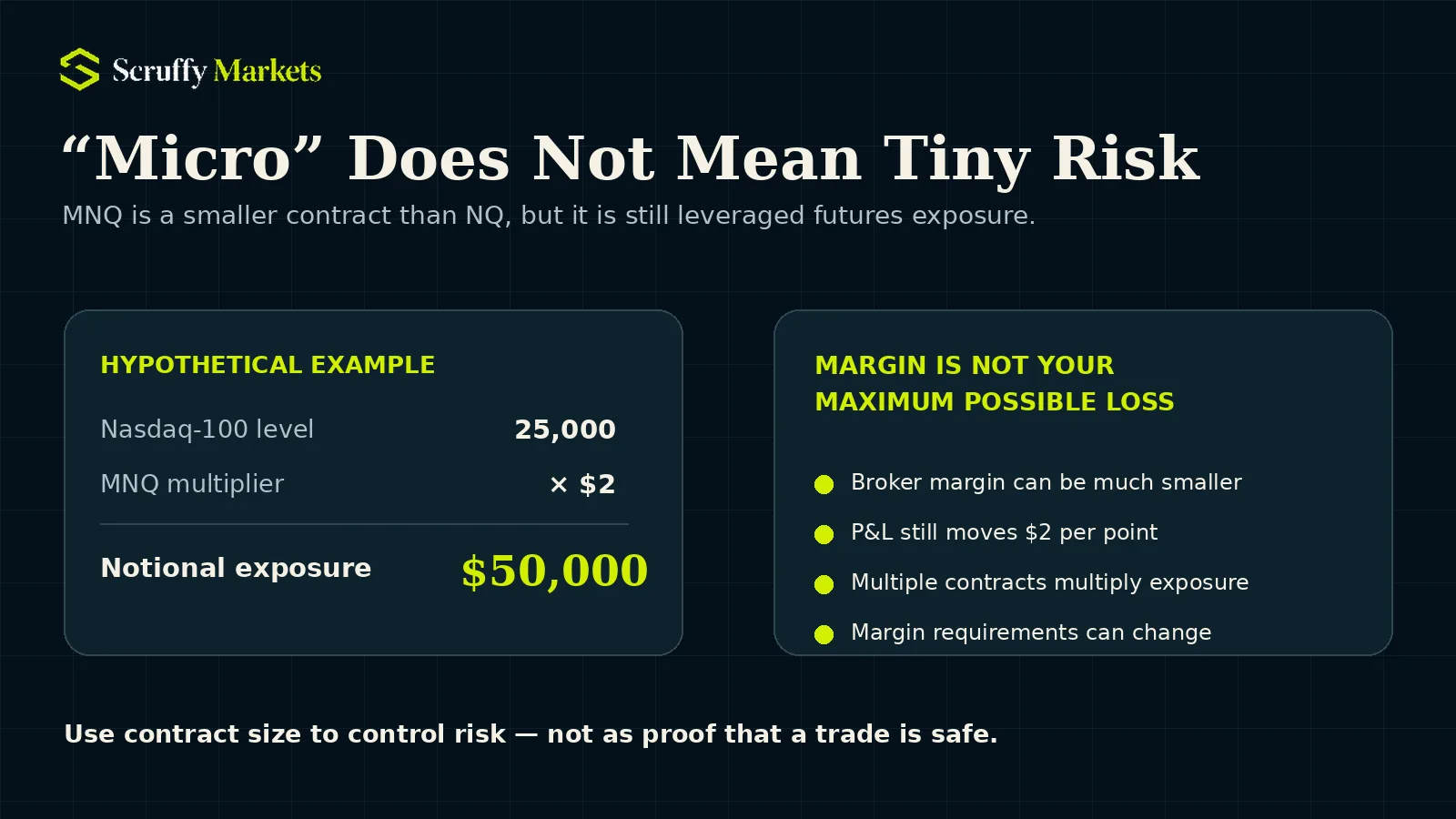
The $2 multiplier tells you how your P&L changes as the index moves, but a futures contract also represents much larger notional exposure.
For example, if the Nasdaq-100 were hypothetically trading at 25,000:
25,000 × $2 = $50,000
One MNQ contract would therefore represent about $50,000 of notional index exposure.
You do not normally need $50,000 in cash to open that contract because futures use margin.
But futures margin is not the same as borrowing money to buy shares. CME describes futures margin as money that must be deposited and maintained against an open futures position, with requirements that can change as market conditions and volatility change. Brokers can also require more than the exchange minimum. CME Group
This is where beginners can get themselves into trouble.
A broker allowing you to open a position with a relatively small amount of capital does not mean that small amount represents the maximum amount you can lose.
The market still moves at $2 per point per contract.
And Nasdaq futures can move hundreds of points.
Is MNQ Good for Beginners?
MNQ can be useful for learning because the smaller multiplier gives you much more control than NQ.
But I would not describe any leveraged futures contract as automatically “beginner friendly”.
There are really two separate questions.
The first is whether MNQ is easier to size than NQ.
It clearly is.
The second is whether somebody understands futures well enough to trade it sensibly.
That depends on the trader.
Before real money is involved, you should at least understand how points and ticks work, how contract quantity changes risk, what your stop represents in dollars, how orders work, when your contract expires and what happens when the market moves quickly.
Those are all things that can be practiced first.
Why Simulation Makes Sense With MNQ
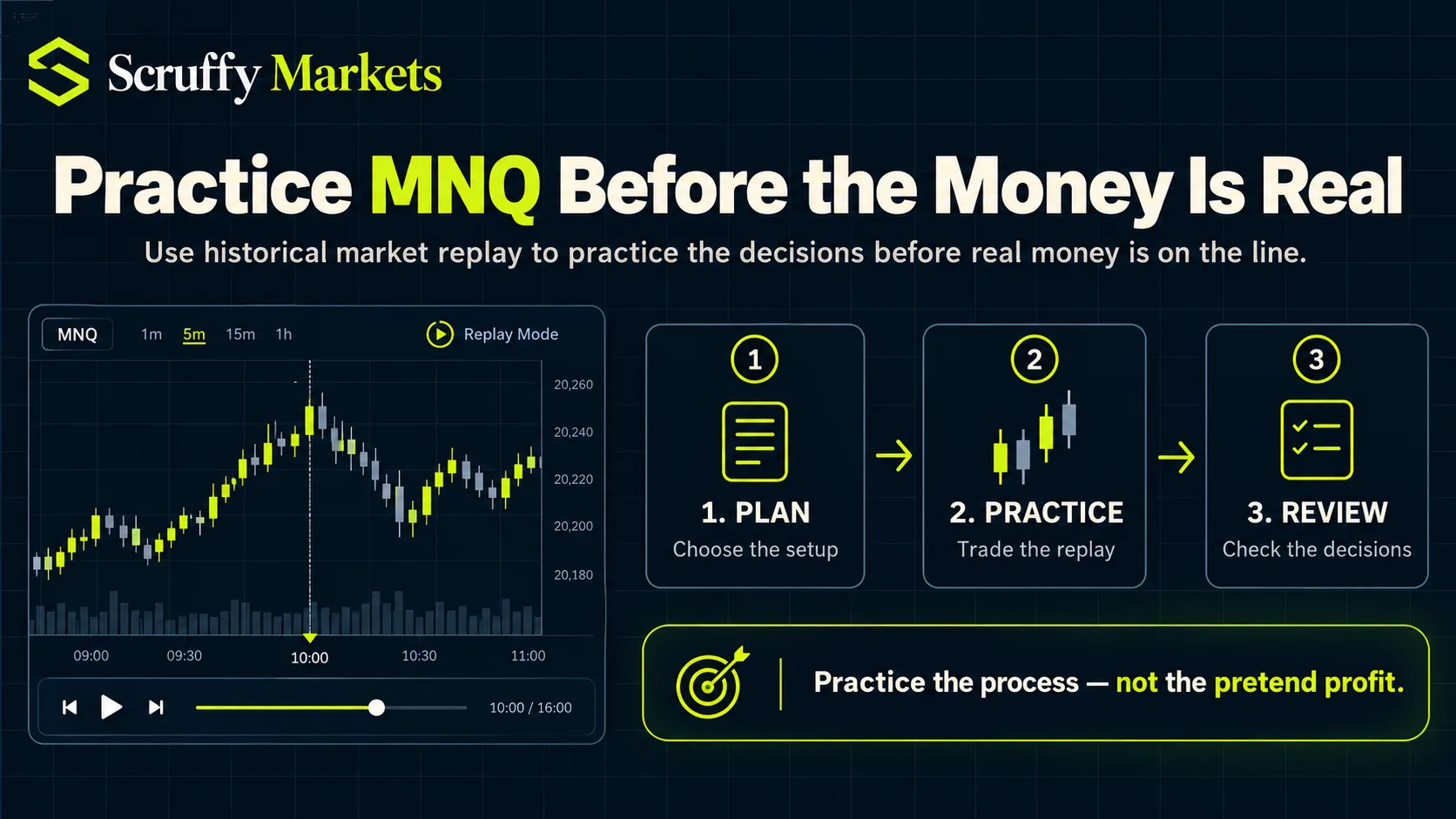
MNQ is particularly useful for trading practice because the maths is simple enough that you can quickly see what your decisions would have meant financially.
Suppose you are practicing with one contract and a 20-point stop.
You know before entering that the price movement represents about $40 of risk.
If the setup appears, you can place the trade, manage the stop and see what happens without needing to change the rules halfway through.
But the useful part is not simply whether the imaginary $40 was won or lost.
It is whether you actually followed the process.
Did you wait for the setup?
Did you enter where you intended?
Did you move your stop because you did not want to lose?
Did one contract suddenly become three after a losing trade?
Did you carry on trading after your session was supposed to end?
Those are precisely the behaviours that simulation and market replay can expose without making real money the price of every lesson.
Scruffy Markets supports futures-market replay, including MNQ, so historical sessions can be traded again while the market unfolds rather than simply studying the completed chart afterwards.
The aim is not to become brilliant at making pretend money.
It is to make the decisions repeatable before the consequences become real.
Common MNQ Mistakes
A smaller contract can solve a position-sizing problem, but it cannot solve a discipline problem.
One common mistake is trading several MNQ contracts simply because each individual contract feels small. Ten MNQ contracts have the same basic $20-per-point multiplier as one NQ contract, so micros can become very large exposure surprisingly quickly.
Another is setting the stop according to the amount of money somebody wants to lose rather than where the trading idea actually becomes invalid. The better sequence is usually to identify the logical stop distance first and then decide whether the contract size and quantity make that trade sensible for your risk limits.
There is also a tendency to treat simulated MNQ profit as evidence that live trading will behave the same way. It won't necessarily. Simulation is extremely useful for learning execution and process, but real-money pressure can change behaviour.
MNQ makes position sizing more flexible.
It does not remove the need for a plan.
MNQ FAQs
What does MNQ stand for?
MNQ is the CME ticker for Micro E-mini Nasdaq-100 futures.
How much is one MNQ point worth?
One full index point is worth $2 per MNQ contract. CME Group
How much is one MNQ tick worth?
The minimum tick is 0.25 index points. At a $2 multiplier, that makes one tick worth $0.50 per contract. CME Group
How many MNQ contracts equal one NQ?
In basic point-value terms, 10 MNQ contracts equal one NQ contract. Ten MNQ are worth $20 per point in total, which matches the $20-per-point multiplier of one NQ. Fees, execution and other trading characteristics can still differ.
Does MNQ trade overnight?
Yes. MNQ trades on CME Globex for almost 23 hours during normal trading days, with a daily maintenance break. CME Group
When does MNQ expire?
MNQ uses the March quarterly cycle — March, June, September and December — with final settlement based on the third Friday of the contract month. CME Group
Is MNQ less risky than NQ?
One MNQ has one-tenth the point-value exposure of one NQ, so the dollar movement per contract is much smaller. That does not make futures trading inherently low-risk, particularly if position size is increased.
Can I practice MNQ without real money?
Yes. Futures simulators and historical market replay can be used to practice MNQ entries, exits, risk rules and trade management without putting real capital at risk.
MNQ in One Sentence
MNQ is simply a smaller Nasdaq-100 futures contract.
It moves at $2 per point and $0.50 per tick, giving traders much finer control over position size than NQ.
That smaller size is useful, particularly for practice and risk control, but it is still leveraged futures exposure.
Understand the contract first.
Then worry about the trade.