
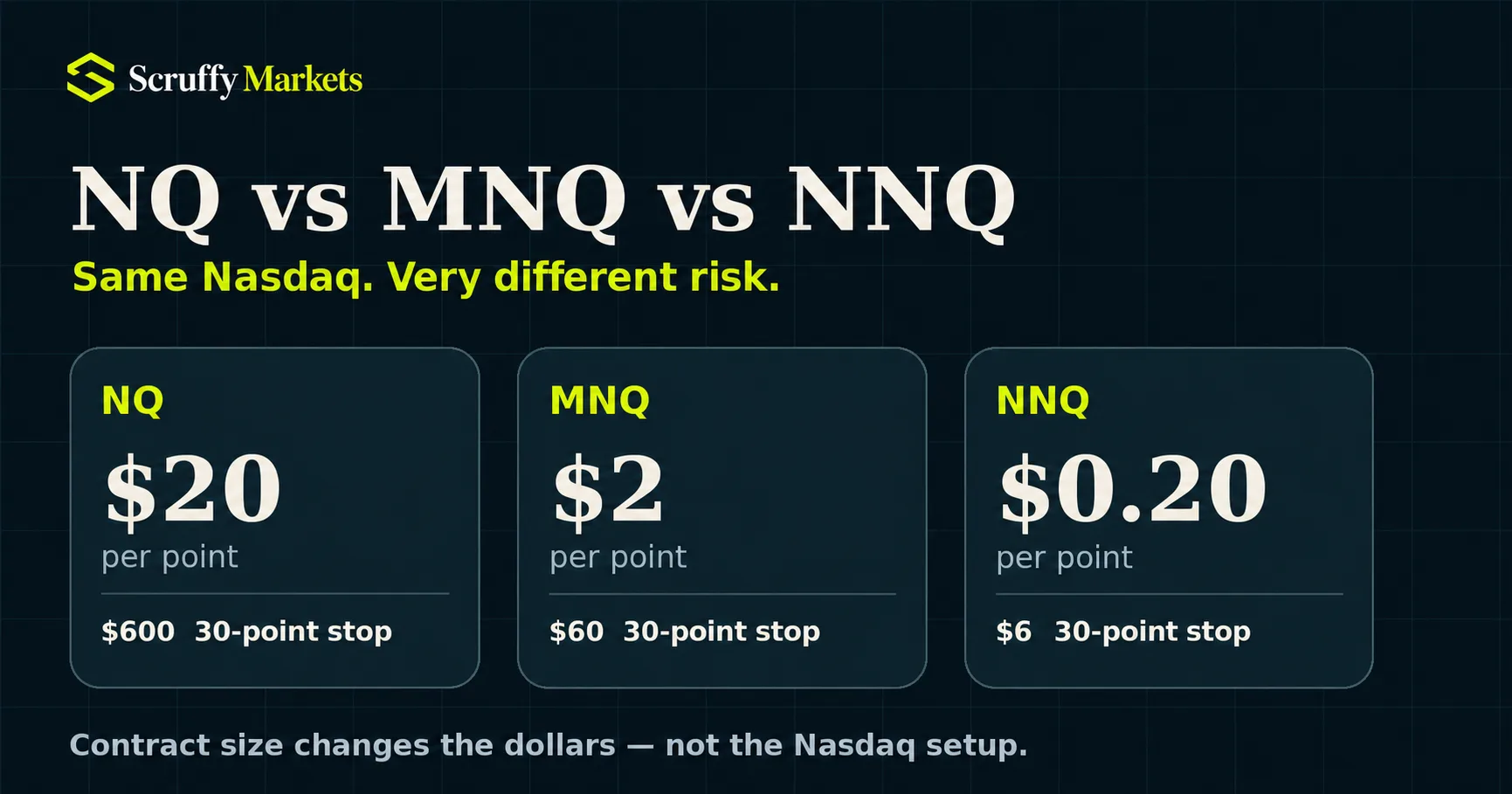
NQ, MNQ and the new NNQ futures contract all track the Nasdaq-100, so their overall price movement is closely related.
What changes dramatically is the amount of money attached to each point.
The standard E-mini Nasdaq-100 contract, NQ, is worth $20 per index point. MNQ, the Micro E-mini version, is one-tenth the size at $2 per point. In August 2026, CME launched NNQ, the E-nano Nasdaq-100 contract, at just $0.20 per point — one-tenth the size of MNQ and one-hundredth the size of NQ. CME Group
That means exactly the same 50-point Nasdaq move can have three very different outcomes.
ContractMultiplierMinimum tickTick value50-point moveNQ$20 per point0.25$5.00$1,000MNQ$2 per point0.25$0.50$100NNQ$0.20 per point0.50$0.10$10
| Contract | Multiplier | Minimum tick | Tick value | 50-point move |
|---|---|---|---|---|
| NQ | $20 per point | 0.25 | $5.00 | $1,000 |
| MNQ | $2 per point | 0.25 | $0.50 | $100 |
| NNQ | $0.20 per point | 0.50 | $0.10 | $10 |
NQ and MNQ both use a 0.25-point minimum tick, while NNQ uses a 0.50-point tick. CME began listing E-nano Nasdaq-100 futures for trade date 24 August 2026. CME Group
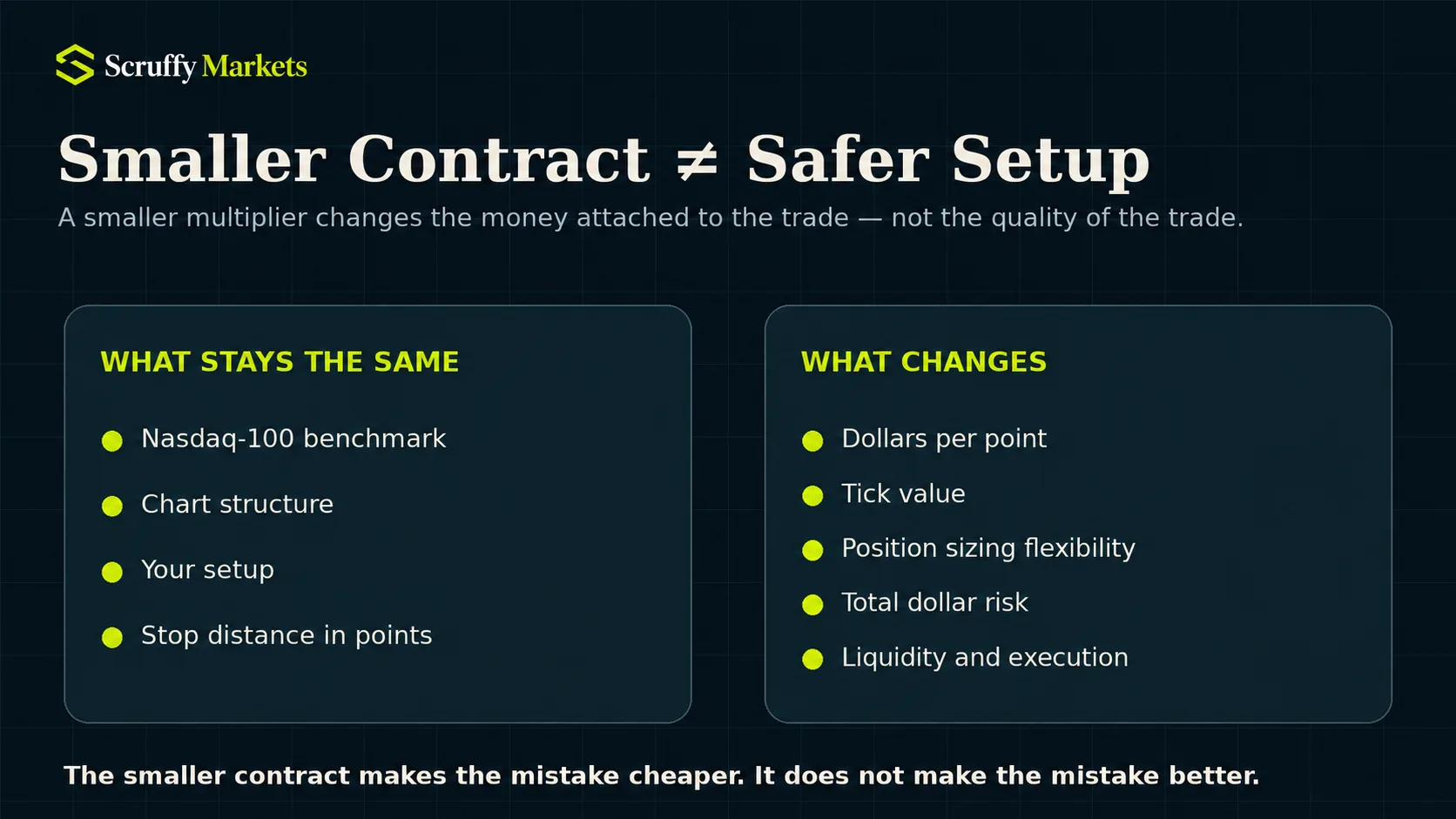
The important thing to understand is that the smaller contract does not make the market itself safer.
It simply makes each point worth less money.
The Same Trade Can Carry Very Different Risk
Imagine you see a Nasdaq setup where the trade is invalid if price moves 20 points against you.
The market structure is the same whichever contract you choose.
But the dollar risk is not.
With one NQ contract, 20 points is $400.
With one MNQ contract, it is $40.
With one NNQ contract, it is $4.
That is why smaller contracts can be useful when learning or when you want more precise control over position size.
The stop still needs to make sense on the chart. The smaller multiplier simply gives you more flexibility over how much money sits behind that stop.
A trader who chooses a poor entry on NNQ has not suddenly made a good trade.
They have just made the mistake cheaper.
Why MNQ Became So Popular
Before MNQ, traders who wanted Nasdaq futures exposure had NQ as the main E-mini contract.
At $20 per point, however, NQ can move a lot of money very quickly.
A 50-point move is $1,000 per contract.
A 100-point move is $2,000.
When CME introduced Micro E-mini futures in 2019, MNQ reduced the Nasdaq multiplier to $2 per point. That made it possible to trade the same benchmark with one-tenth of the point-value exposure.
The smaller contract clearly found an audience. CME says around 4.5 billion Micro E-mini futures contracts have traded since the suite launched in May 2019, and MNQ reached a record monthly average daily volume of 3.2 million contracts in June 2026. CME Group
For traders, the attraction is fairly obvious.
A 100-point move on MNQ is $200 rather than $2,000 on NQ.
That does not remove risk, but it gives traders far more control over how much money is attached to each decision.
So What Is NNQ?
NNQ is the newest and smallest Nasdaq-100 futures contract in the CME range.
Its full name is E-nano Nasdaq-100 futures.
The contract multiplier is $0.20 per index point, compared with $2 for MNQ and $20 for NQ. CME describes the E-nano range as one-tenth the size of the corresponding Micro E-mini contracts. CME Group
The tick size is slightly different too.
NQ and MNQ move in minimum increments of 0.25 points.
NNQ moves in minimum increments of 0.50 points, with each tick worth $0.10. CME Group
That makes NNQ particularly interesting for traders who want very small exposure while still trading an actual futures contract.
A 50-point move on one NNQ contract is only $10.
A 20-point stop is $4.
A 30-point stop is $6.
That gives traders another step between pure simulation and the larger Micro or E-mini contracts.
Ten MNQ Equals One NQ in Point-Value Terms
This is where contract quantity starts to matter.
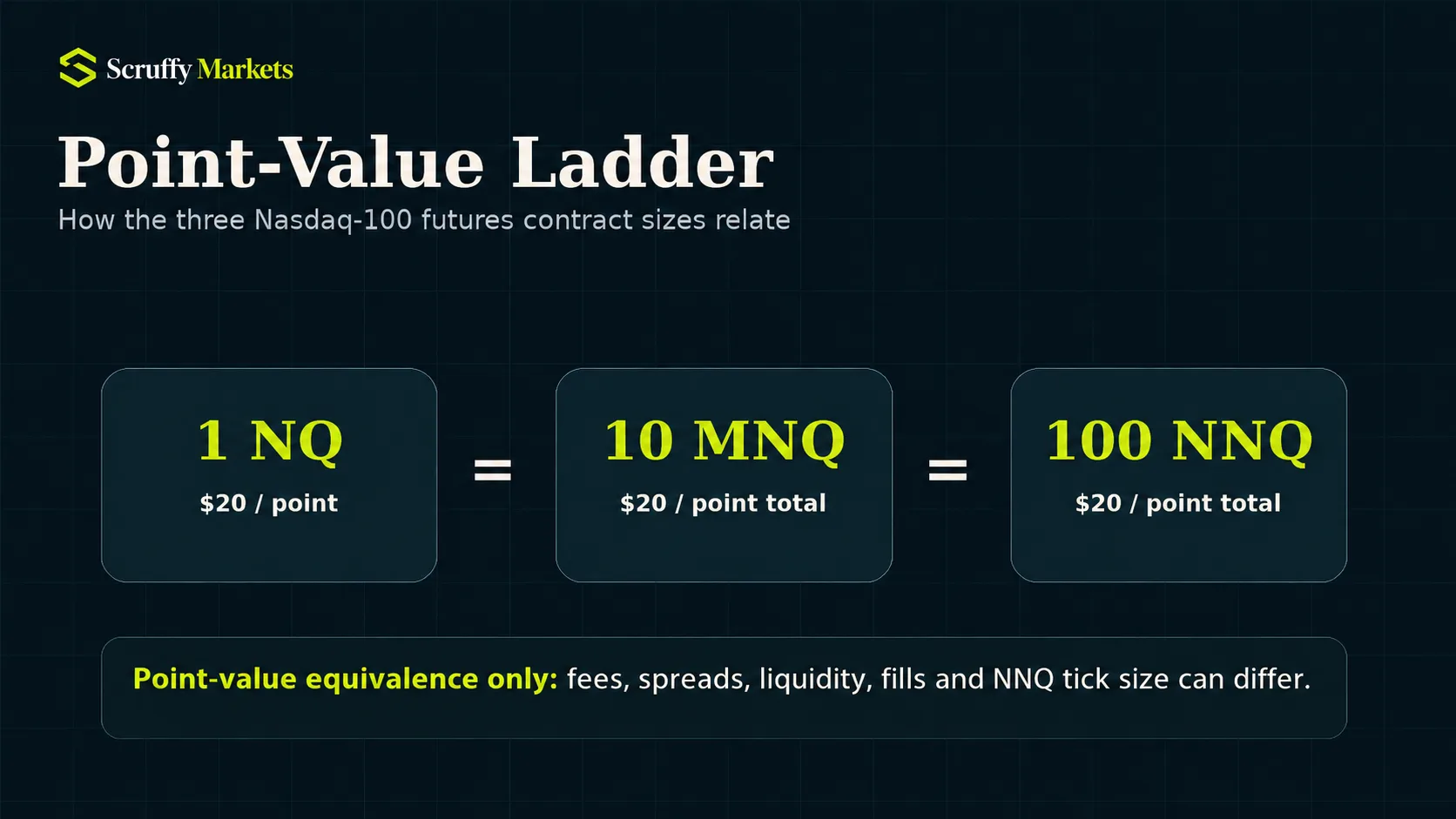
One NQ contract is worth $20 per point.
Ten MNQ contracts are also worth $20 per point in total.
Likewise:
10 NNQ = 1 MNQ
and
10 MNQ = 1 NQ
in simple point-value terms.
So a 100-point move would equal:
1 NQ = $2,000
10 MNQ = $2,000
100 NNQ = $2,000
That does not mean those positions are identical in every respect.
Commissions, exchange fees, bid/ask spreads, liquidity and execution can all differ, and NNQ also has a different minimum tick size.
But the basic multiplier maths is straightforward.
This is why simply saying “I only trade micros” does not tell you much about somebody's actual exposure.
Ten MNQ can carry the same basic dollar-per-point exposure as one NQ.
Smaller Contracts Give You More Control
The real advantage of smaller contracts is flexibility.
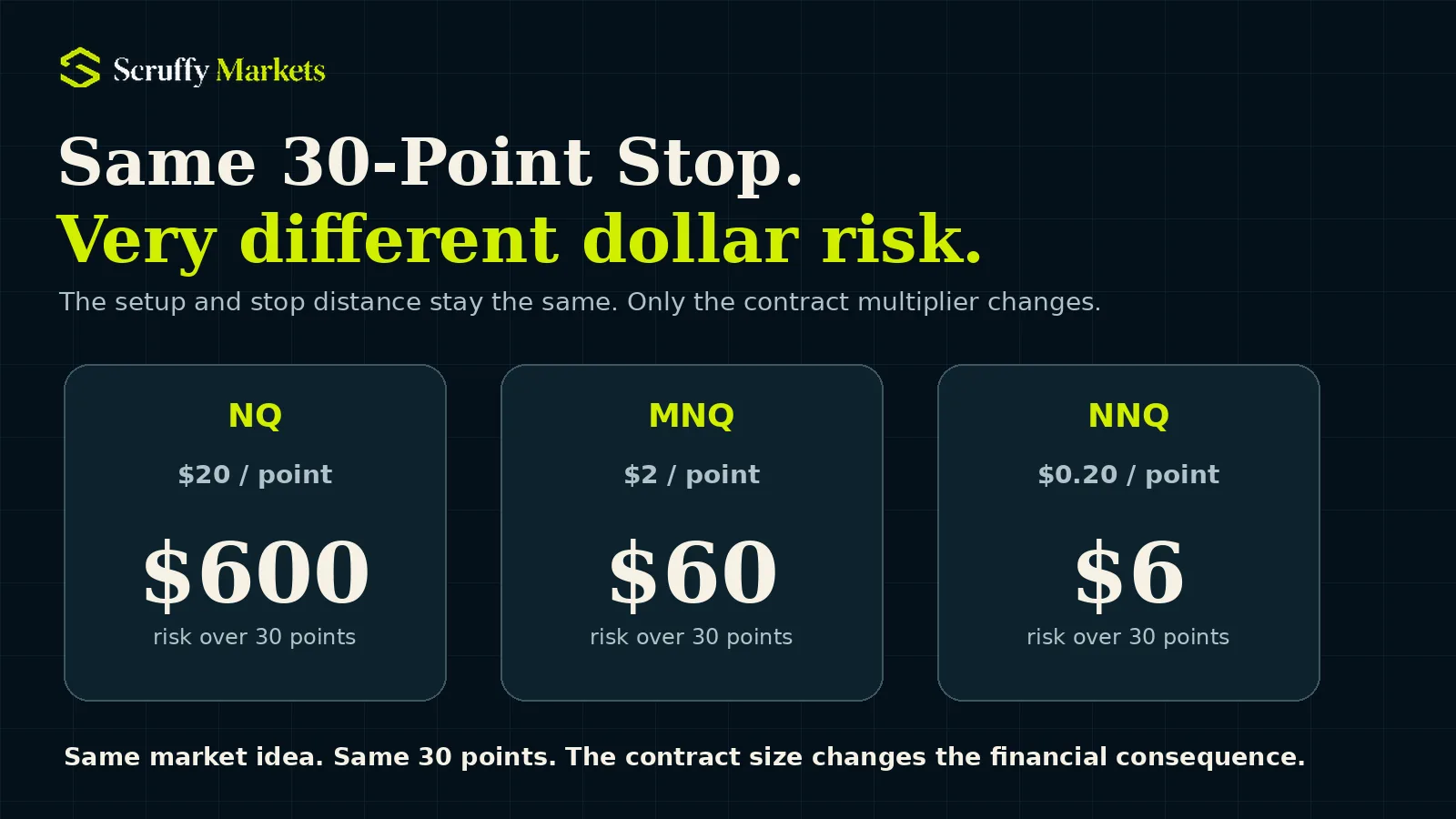
Imagine your setup requires a 30-point stop.
If you trade one NQ, that stop represents $600.
With one MNQ, it represents $60.
With one NNQ, it represents $6.
The market has not changed.
Your strategy has not changed.
Your stop has not changed.
Only the money attached to each point has changed.
That means the smaller contracts can make it easier to keep a technically sensible stop without forcing yourself into a level of dollar risk that does not suit you.
They can also make scaling more gradual.
Moving directly from one MNQ to one NQ increases the basic point-value exposure tenfold.
Using smaller contracts lets you increase or decrease exposure in smaller steps.
NQ Is Not a More “Advanced” Version of MNQ
There is sometimes a strange idea that trading NQ somehow means somebody has graduated from MNQ.
It does not.
The contracts track the same Nasdaq-100 benchmark. The main difference is size.
A trader who cannot follow their rules on MNQ will not suddenly become disciplined because each point is now worth ten times more.
If anything, the larger dollar swings may make existing behaviour more obvious.
The skill still comes from recognising your setup, controlling risk and following your process.
Increasing the contract multiplier does not improve any of those things.
It just increases the financial consequences.
What About Liquidity?
This is one area where the three contracts should not be treated as identical.
NQ and MNQ are established contracts with substantial trading activity.
NNQ only launched in August 2026, so its liquidity and trading volume are much newer.
That means traders considering NNQ should look at the actual volume, spreads and order-book conditions at the time they trade rather than assuming the execution will be identical to NQ or MNQ.
This matters particularly for short-term trading, where spreads and fills can make a meaningful difference.
A contract can look perfect on paper because of its smaller multiplier, but execution still matters.
Which One Should You Practice?
The answer depends less on which ticker sounds best and more on the risk your trading setup actually requires.
Start by looking at the size of your normal stop.
If your typical stop is 20 points, calculate what that means in NQ, MNQ and NNQ.
If it is 50 points, do the same.
Then ask whether that level of exposure fits the way you intend to trade.
If you are practicing in a simulator, use realistic contract sizes rather than treating the fake account as unlimited money.
There is little value in practicing carefully with one MNQ and then jumping into five NQ contracts simply because the simulator lets you.
The chart might look similar.
The financial impact will not.
That is exactly the sort of thing simulation is useful for: making the process familiar before real money is involved.
MNQ vs NQ vs NNQ: The Simple Version
All three contracts give you exposure to the Nasdaq-100.
NQ: $20 per point
MNQ: $2 per point
NNQ: $0.20 per point
Each step down reduces the multiplier by a factor of ten.
NQ and MNQ have a 0.25-point tick.
NNQ has a 0.50-point tick.
The best contract is not automatically the biggest one or the smallest one.
It is the one whose size makes sense for the trade you are taking.
A 30-point stop is still a 30-point stop.
But on NQ it is $600.
On MNQ it is $60.
On NNQ it is $6.
Same Nasdaq.
Very different consequences.